Monthly Archives: January 2013

Insectifying Illness in Kafka’s The Metamorphosis

In Franz Kafka’s The Metamorphosis, Gregor wakes up to find that his “anxious dreams” are in fact reality: he has been changed into a “monstrous verminous bug” (1). Late for work, he struggles to free himself from the confines of his bed but is unable to escape. His family begins to knock anxiously on his door, and his manager scolds him angrily for his tardiness. Gregor tries to respond in self-defense, but he can no longer speak in words and is not understood by the others. With great effort, Gregor makes his way to the door; at the sight of Gregor, the manager departs hurriedly and the family stands aghast.

Gregor’s ill state has been established, and he is kept in his room. His sister feeds him and takes care of him eagerly at first, keeping his room clear so he can crawl around. His father seems to stay strong in denial while his sensitive mother pines. Gregor hides from his family by situating himself under the couch and shielded by a sheet. On one occasion, Gregor’s mother faints at the sight of her son and Gregor’s father lashes out at him, throwing apples that result in an immobile state of injury for Gregor.

Since Gregor had been the primary breadwinner for the family, each family member is forced to step up and take on new responsibilities for pay. The family takes on three tenants to help pay for rent. When they see Gregor, they immediately decide against the lease, disgusted by the familr. For the Samsa family, this is the last straw. Gregor is no longer a “he” but an “it” instead, which allows them to forfeit their claim and responsibility for him. That night, Gregor dies. Gregor’s death frees the Samsa’s, for their lives no longer need revolve around him, and they are able to return to a state of normalcy.

I have always found Kafka’s works to be incredibly compelling, and this one certainly did not disappoint me. One of the things that I found to be most fascinating was the role of the 3rd person omniscient narrator. Although the story seemed to be told through the eyes of Gregor, the narrator was not inside his head but rather an objective observer. I felt that the narrator’s intimacy with Gregor was transformed just as Gregor’s own transformation evolved throughout the novella. As Gregor’s insect identity became more and more consuming, the narrator joined the Samsa family in distancing himself from Gregor. If anything, this shows just how isolating Gregor’s insectification really was- even the narrator who is telling his story abandons him.

Discussion Questions:

1. What parts of the text can be identified as representative of a chaos narrative? A quest narrative? A restitution narrative?

2. What words does Kafka use to allude to Gregor’s insect-like state?

3. What is the effect of the 3rd person narrator? How does the narrator’s stance evolve throughout the novella?
2 Comments

Filed under Independent Study, Literary Narratives

The Art of Illness

What I find fascinating about the idea of using art to express the illness experience is that it translates the physical and mental components of illness into a visual image. While some illnesses are often visible, others remain invisible. Art has the power to visually illuminate the visible and unveil the invisible.

As I explored artistic depictions of illness, I found that art seemed to be used in three main ways: to encourage another person’s illness experience, to express one’s own illness experience, and to depict the illness experiences of others.

Fiber Arts and Loose Ends includes a series of quilts created as tributes to survivors, an uplifting collection for sufferers. While some are more abstract, including depictions of plants used in cancer treatment, others incorporate language into this artistic medium. Words of Love by Annabel Ebersole incorporated the words “Courage,” “Love,” “Faith,” “Belief in Miracles,” “Hope,” and “Trust.” These encouraging words reminded me of the triumph narrative, but they also embody an optimistic take on the quest narrative.

While art is sometimes turned to for relief and encouragement, it can also be used as a space for self-expression and release. William Utermohlen used art as a form of narrative, to tell the tale of his transformation with Alzheimer’s. His drawings reflect his gradual loss of self and identity through the distortion of his facial features. Incorporated colors seem sporadic (the fourth drawing in particular seems to reflect the chaos narrative), until ultimately Utermohlen has become a faceless black and white charcoal sketch.

In addition to providing support for the ill, art can be used to spread awareness to the well. The Scar Project is a particularly powerful photography collection of breast cancer survivors, especially depicting women who have had mastectomies and are redefining the female body. With the motto “Breast Cancer Is Not A Pink Ribbon,” these works are a direct resistance against the pink ribbon that has become the face of breast cancer (and is also a form of the triumph narrative). These works also revise the restitution narrative of breast cancer by suggesting that rather than a return to normalcy, breast cancer can result in a redefinition of the female body and female identity.

Just as Frank’s narrative categories often overlap and intertwine elements of illness, art seems to transform and evolve illness, achieving a multiplicity of narratives within a single work of art.

Leave a comment

Filed under Independent Study, Visualizing Illness

Concluding Ideas about Frank and Conway

In the second half of Illness and the Limits of Expression, Conway explores the literary methods of metaphor, narrative form, and endings. While Sontag critiques metaphor as something that confines individuals within stereotypes, others see metaphors as necessary to come as close to an accurate representation of the illness experience as possible.Narrative form often strives for linearity, a beginning, middle, and end; individuals seek to construct this sense of coherence but also to expose the interruptions and interjections caused by illness.

Conway discusses the complexity of the ending, and how there is often a desire to end on a happy note. Some authors feel themselves gravitating towards this triumphant conclusion, but they catch themselves in time to adopt an ending that is better suited with the rest of their narrative.

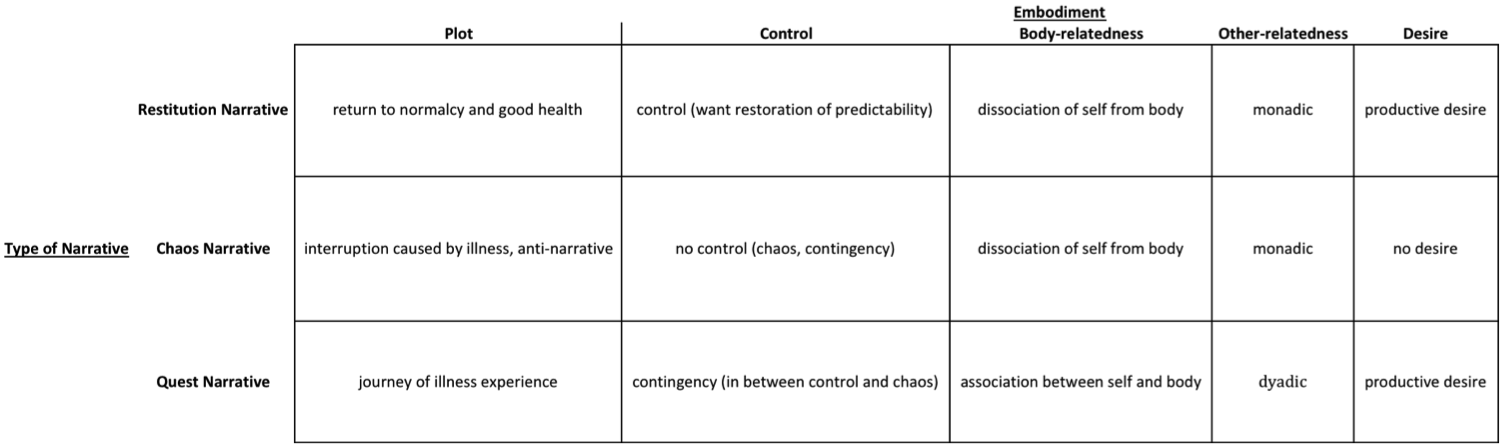
After laying out a basic foundation of illness narratives, Frank delves into his three types of illness narratives: the restitution narrative, the chaos narrative, and the quest narrative. He argues that illness narratives often contain elements and moments of each of these perspectives, and he explores the defining characteristics of each [see table].

The restitution narrative focuses on the conclusion of illness, the ultimate victory over illness, an individual’s reintegration into society and return to the normalcy of everyday life. The chaos narrative claims that “chaos is told in the silences that speech cannot penetrate or illuminate”; thus, the chaos narrative is an anti-narrative that highlights the interruptions caused by illness (101). The quest narrative focuses on the temporal enactment of the illness experience and an individual’s transformation over time.

Frank explains how these narratives coexist and intermingle to compose the illness experience. He toys with the idea of patients as witnesses to illness and illness narratives as a kind of testimony. The concluding chapter explores suffering, for “all illness stories share a common root in suffering as ‘an existential universal of human conditions’” (170). He relates suffering to illness narratives by showing how both telling and hearing stories has the power to heal.

This table outlines the 3 types of illness narratives. Click to enlarge!

Types of Narratives

Discussion Questions:

1. What literary characteristics of an illness narrative can hint at a shift in the type of narrative? For example, what syntax, diction, etc.?

2. How does classifying the narrative type affect the analysis of an illness narrative?

Leave a comment

Filed under Independent Study

Celebrating MLK Day: Listening to Health Disparities

The entire auditorium was silent as eyes followed the words on the screen and absorbed the image of the patient in a hospital room. These moments of patient narratives were interspersed throughout Dr. Carmen Green’s presentation today (the 50th anniversary of the “I have a dream” speech)  at the Martin Luther King, Jr. Symposium organized by the Health Sciences Program at the University of Michigan. People from all across campus, from the schools of medicine, dentistry, public health, pharmacy, etc., had all gathered to learn more about “Unequal Burdens and Unparalleled Opportunities: Achieving the Dream for Health and Pain Care Equity.”

Dr. Green is an accomplished woman, a Professor of Anesthesiology, Obstetrics and Gynecology, and Health Management Policy. Her passion and interest in addressing health inequalities was incredibly inspiring. Throughout her presentation, she balanced her personal experiences with shocking facts about American health care and disparities in treatment.

In addition, Dr. Green acknowledged the importance of listening and storytelling in health care. She admired “the power of narrative to embrace the art and science of medicine,” to transform it. It was exciting to see her advocate on behalf of this communication through language, because it helped bring to life some of the theories that I have been reading about. She demonstrated that narratives are indeed giving patients a voice, and slowly but surely, more and more physicians are listening.

Her take-home message about narratives was that “we need to be able to listen actively, not passively.” This distinction stands up agains the common practice of failing to be engaged in conversation with patients. This means to pay close attention to the patient as a whole, the patient’s body language, the patient’s disposition, the patient’s praises, the patient’s complaints. Not only hearing everything that a patient says, but also responding to the patient. Failure to do so undermines the patient (this reminded me of Oliver Sacks’  A Leg to Stand On, which I haven’t read yet but Frank’s novel makes me feel as though I have). Particularly in regards to addressing pain inequity, I think that understanding and reacting to narratives is crucial, and Dr. Green’s placement of narratives throughout her talk suggests that she agrees.

Dr. Green’s talk concluded powerfully with her own dreams for what the future will hold 50 years from now, in 2063. She remains optimistic about our future: “Our strength is in our diversity and in our ability to see through multiple lenses.”

To see through multiple lenses, to hear through multiple narratives.

Leave a comment

Filed under Miscellaneous Musings

Narrating Illness through Dance

This week, I’m on the look out for non-narrative illness narratives. Expressions of the illness experience that occupy any form of media.

I’m beginning my exploration of multimedia illness narratives with dance. As someone who has danced forever, I have always been fascinated by movement. Recently I have learned about dance therapy and movement programs, and I love how dance and movement have been adapted to help with coping.

I began with a youtube search for ‘illness dances’.

This first video is called Schizophrenia, and is “loosely based” on the illness.

These movements embody the marriage of chaos and calm, of sharp and fluid, of control and collapse.

Another video I found is called “An Interpretation of My Illness- Crohn’s disease.” Unlike the previous one, this dance is choreographed by an individual who has the illness that the dance expresses.

Her incorporation of movements on the floor demonstrate the “falling” aspects of her illness, the numerous head rolls reveal her anguish. An interesting aspect of this dance is the song chosen: “Her Diamonds” by Rob Thomas, a song written for his wife who has an auto-immune diseases.

Last but not least, how can I forget my own dance loosely choreographed about autism? After seeing this video, I was inspired to choreograph a dance last year to “Fix You” by Coldplay.

It’s interesting to look back on my own choreography through the lens of illness narratives. I didn’t even realize that I was depicting the light of triumph narratives. At the time, I described the circle as a moment of “chaos,”; now it seems like those movements express the “chaos narrative” that words cannot capture.

Haven’t had enough dance illness narratives? Here’s an epic production of “Childhood Illness…Our Story”, Part 1 and Part 2, telling the tale of “a mother and young daughter’s journey through chemotherapy.”

Leave a comment

Filed under Dance, Independent Study

Accepting the Limits of Language

While Arthur Frank’s The Wounded Storyteller explored the potency of illness narratives, Kathlyn Conway’s Illness and the Limits of Expression exposes the shortcomings inherent in many of these works. Conway outlines the paradoxical nature of illness narratives: “Literature offers the possibility of representing the shattering experience of illness, but it proves woefully inadequate for depicting the nature of physical pain and the dissolution of the self” (16).

Language as a form of expression, as a means of communicating physical or mental stress, falls short of its demands. Conway denounces the most popular form of illness narratives: the triumph narrative. This form of expression finds fault in its glorification of the illness experience. Often, these are written at the conclusion of an illness experience and reflect on past experiences rather than chronicling illness through its progression. This narrative form aligns with the cultural American belief that “anything is possible,” which makes it of great appeal to the general public (6). These stories are of overcoming illness and disability, of rising above the challenges that they present, and ultimately emerging from this learning experience with enduring strength.

Despite the temptation of reconstructing past illness as triumph narratives, Conway advocates for the importance of non-triumph narratives. She claims that a triumph narrative “enables individuals and the culture to ignore the needs of the ill and disabled,” when instead, illness narratives should illuminate the vulnerabilities of these conditions and the resulting implications (24). Illness narratives present an opportunity to strip illness down to its roots, to boldly expose it for what it is. These narratives track the evolution of the illness in conjunction with the evolution of the self.

Conway exposes the paradoxical nature of illness natures. Literature empowers those who experience illness, but it simultaneously belittles that very experience. While language allows individuals to dissociate the self from the body and to express physical pain through mental thought, narratives also enable the reclamation of the body through an intimate and honest engagement with illness.

Discussion Questions:

1. In what ways are illness narratives paradoxical? What does this paradox reflect about illness? (55)

2. Why does Conway choose to address illness and disability together? How does this affect her argument and her definition of these terms? (14)

3. What is the right way to react or interpret illness narratives? Or rather, is there a right way? (19)

Leave a comment

Filed under Independent Study

Revelations of an Impaired Listener

Frank presents a number of fascinating ideas that have exceeded my expectations by showing how interesting illness narratives are. He outlines how the evolution of illness from premodern to modern to postmodern times. Illness was initially alienated from the disease, which Kleinman defines as the pathological component, because medical terminology existed in isolation as a sort of foreign language. Modern times involved an acknowledgement of illness as a component that was equally as important as disease, while postmodern times have taken this a step further to empower illness with a voice that now echoes through illness narratives.

A fundamental idea that Frank presents is as follows: “The mystery of illness stories is their expression of the body: in the silences between words, the tissues speak.” This situates illness narratives in an in-between state; they transform physical experiences of the body into emotional experiences of the mind, and then translate them into language. Because I’m fascinated about ideas regarding the mind and the body, I wonder how illness narratives fit into this divide and how these aspects of an individual influence this form of communication. According to Frank, illness narratives include four problems with the body: “control, body-relatedness, other-relatedness, and desire” (29). He also categorizes depictions of the body into four different types: “the disciplined body, the mirroring body, the dominating body, and the communicative body” (29).

Perhaps what I found to be most compelling was the idea that there really is no such thing as a singular illness narrative for an individual. Each individual shares multiple illness narratives, largely shaped by the audience and the purpose of its telling. This traps individuals within a multilingual “narrative wreck,” so to speak, a heterglossic discourse. As a result, there are multiple ontologies to illness, and each narrative shapes illness into a different entity. Despite the multiplicity of illness narratives and illnesses themselves, I find it slightly paradoxical that these all originate within a single body.

Realizing that narratives are told in variations has changed the way that I listen. It’s fascinating to see how conversations unfold based on those involved. As I was volunteering at Mott’s Children’s Hospital, I couldn’t help but hear dialogues differently. Conversations with different individuals illuminated different aspects of an illness, depending on the listener: a doctor, a nurse, a child life specialist, a family member, a friend. Just as illness narratives can empower individuals with a voice, exploring them can also provide listeners with the power to hear.

Discussion Questions:

1. Metaphor is common in illness stories. When is it appropriate to find symbolism in illness, and where does the boundary lie? (57)

2. How do illness narratives exist temporally? What transformations do they initiate, especially with regards to individual identity and the multiple ontologies of an illness in the past, present, and future? (60)

3. How does narrative truth function in narrative illnesses, and what is its importance? Frank claims that “in illness stories, truth may be selective, but it remains self-conscious” (62). What does he mean by this, and how can this be seen in present illness narratives?

Leave a comment

Filed under Independent Study

A New Year, A New Blog

Hello 2013! Here’s to beginnings.

First off, let me introduce myself. I’m Trisha Paul, a junior at the University of Michigan pursuing a B.S. in Honors English with a minor in Medical Anthropology. I hope to attend medical school and, eventually, become a Pediatric Oncologist.

I came to college with a fascination for medicine, a love for literature, and an uncertainty about how to pursue both. At the time, I figured that I could major in English in undergrad, then shift gears and head to medical school. Freshman year, however, showed me that these interests were not quite as different as I thought.

I remember reading a New York Times article about Abraham Verghese. I was so excited to see that I wasn’t the only one to share interests in medicine and in literature. I even emailed Dr. Verghese just to tell him how inspiring it was for me to read about his life, and that I have often felt the same way about how medicine and writing require “an infinite curiosity about other people.” I was pleasantly surprised to even get a response from him!

I started to come across other doctors like Perri Klass who shared an interest in literature. There’s even a wikipedia page about physician-writers. The more I learned about these individuals, the more I became convinced that there was a way for me to intertwine my interests in literature and medicine in my future career.

And that’s when I learned about the field of Narrative Medicine. A fellow pre-med English major told me about Columbia University’s Program in Narrative Medicine, which educates leaders who will “imbue patient care and professional education with the skills and values of narrative understanding.”

This program embodies exactly what I had hoped to do; it encourages an exploration of the “and” between literature and medicine. I began delving into this intersection through a number of works: Anne Fadiman’s The Spirit Catches You and You Fall Down, Abraham Verghese’s My Own Country, Susan Sontag‘s Illness as Metaphor, Siddhartha Mukherjee’s The Emperor of All Maladies, Rebecca Skloot’s The Life of Henrietta Lacks. The more I read, the more intrigued I become.

At the University of Michigan, there was even an English course offered that explored illness narratives with Howard Markel, another incredible physician-writer. I was eager to take the class and devastated when it was cancelled. Determined to still read the material, I emailed Alexandra Stern, the professor who co-taught the class in the past, with hopes of doing an independent study.

And thanks to Professor Stern’s enthusiasm, that’s what I’ll be doing this semester – studying Illness Narratives: Literature and Medicine. I’m so excited that this worked out, and I can’t wait to learn more about this fascinating body of literature. This blog will be a place for me to reflect about the works that I encounter, to struggle with the text and the ideas that I come across.

I look forward to continuing my investigations of illness narratives even after this semester. It’s a new year, and I’m excited about the new adventures that it brings.

Leave a comment

Filed under Miscellaneous Musings