Tag Archives: childhood cancer

Notes Left Behind: Journaling about a daughter’s cancer

“She is simple. She is our Elena” (x). A grown-up, 5-year-old girl who loved hearts, dresses, and the color pink. Her life was colored by her experiences with DIPG, a rare form of brain cancer.
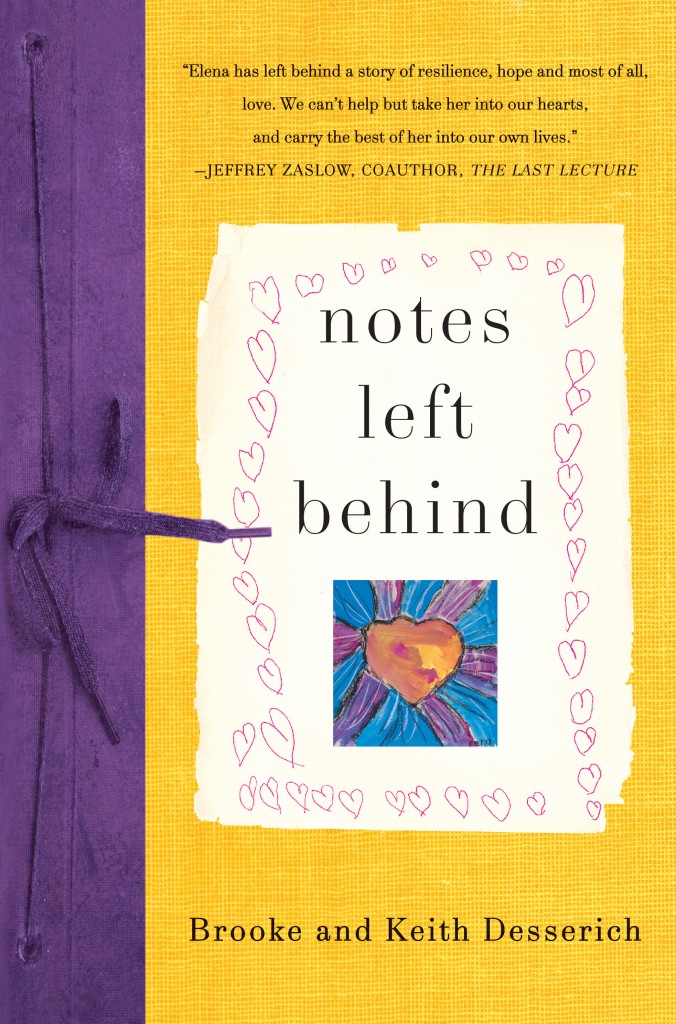
notesNotes Left Behind is a collection of journal entries written by Elena’s parents, Brooke and Keith Desserich. What began as a preservation of memories to share with Elena’s sister Gracie quickly became more meaningful to both the Desseriches and  all those who cared about Elena. 

The Desseriches chronicle their letters by the date and the number of days since diagnosis, the day Elena was given an estimate of 135 days to live. Brooke and Keith take turns writing entries that coalesce to provide a more holistic, parental view of caring for a child with cancer and her sibling.

While Elena wrote many notes to her loved ones, “this book too is a note from Elena, messages from a little girl who taught our family so much about life” (xiv). Elena’s sweet, sincere personality shines through the eyes of her parents, who share with us her experiences in losing her voice,  gaining weight from steroids, and wanting nothing more than to be normal once more.

In the face of cancer, questions emerge about the daunting uncertainties and the forgotten nuances. Keith grapples with these question marks and calls out our band-aids, noting that “cures don’t come on toy shelves and they don’t have tags” (64). He reminds us that these material objects are powerful yet insufficient when lives are still at stake. It’s refreshing to remember that at the root of each childhood cancer is a need for a cure.

Inspired by their personal experiences with the incurable, the Desseriches started the organization The Cure Starts Now. With an emphasis on finding a cure for brain cancer, this organization believes that a cure for all cancers can be found in this elusive disease. Elena has touched the lives of those around her and more.

She has left behind more than notes.

Leave a comment

Filed under Chronicling Childhood Cancer: Illuminating the Illness Experience through Narrative, Literary Narratives

Angels & Monsters: A child’s eye view of cancer

Godzilla stands next to a purple hospital, breathing out engulfing flames of fire. He is burning out cancer.

This drawing was one of many to inspire art therapist Lisa Murray to share the work of children with cancer. Photographer Billy Howard is also dedicated to these children, capturing their personalities through a camera lens. Together, Murray and Howard set out to bridge their representations of these children. Murray let children illustrate what it feels like to have cancer through the medium of their choice, then wrote out their explanations. Howard photographed each child individually, honoring their personal journeys with cancer.

Angels & MonstersGodzilla vs. Cancer was an art gallery exhibition in 1994, sharing the illustrations, explanations, and photographs of 25 children with a larger audience outside the Pediatric Oncology ward. Eight years later in 2002, 17 of the children had survived. These creations along with biographies and a list of resources were compiled to create the book Angels & Monsters: A child’s eye view of cancer.

Cancer brings out fear: tears, pain, sickness, confusion, isolation, and band-aids. But it also brings out friendships, faith, perspective, and love. While each artistic piece offers insight into each child’s perspective, black and white photographs showcase each child’s self. On a swing, with a superhero cape, by a window, curled in a bed. Each work of art and the rationale behind it is compelling, each photograph and each child beautiful.

The authors reflect honestly with simple yet profound understandings of these children and their journeys. I loved the phrase that Jeff Foxworthy uses in the forward to describe these children: “old souls in little bodies” (viii). These individuals exhibit the precision of language as they carve out childhood cancer. They invite us to into “a special world. No artifice exists there. The human spirit holds sway with complete honesty and great dignity” (6).

Leave a comment

Filed under Chronicling Childhood Cancer: Illuminating the Illness Experience through Narrative, Literary Narratives, Visualizing Illness

Beyond the Face of Illness in Lucy Grealy’s Autobiography of a Face

Although Lucy Grealy’s title Autobiography of a Face suggests an emphasis on her physical transformation in response to cancer, I believe that her novel feels more like an Autobiography of a Soul. As a child, she was diagnosed with Ewing’s sarcoma; for her, cancer of the jaw bone. But rather than focus on merely the corporeality of her cancer, she expresses its indirect, internal invasion of the self through written word.

Grealy seeks refuge in the attention she receives in the medical sphere, a space that imperfectly fills the void created at home. In writing, she travels through her life experiences and allows the reader to explore the inner depths of her mind as she retrospectively relives the past. She discusses her traumatic experiences with cancer:  unforgiving treatments of chemotherapy, radiation, and surgery; the futile persistence of reconstruction.

Although initially unaware of the implications of such an illness, her maturation over the years enables the appearance of psychological scars. Grealy defines her burden of depression, her feeble sense of identity, her struggle to conceptualize and cope with beauty, her hopeless disregard and perpetual desire for love.

Cancer certainly provides a backdrop, or rather a catalyst, for Lucy Grealy’s story, but her story is so much more.  Woven through her work is a thread of tension between her external and internal persona, between her face and her soul. The disjunction between these situates her within struggles larger than the physical disease. 

What struck me is that Grealy makes a point of resisting an illness narrative understanding of her story. Instead, she regards cancer as “not the part of the story I’m interested in” (230). Unlike a majority of patient illness narratives, Grealy is a writer. Her profession has shaped her grasp of language and eloquent creation of memoir (or recreation of memory).

This raises the question: to what extent should a narrative about illness be defined as such, and how does it artistically escape this narrow scope? What I mean is that yes, Grealy discusses how cancer affected her life, but does this focus overshadow the merit behind her novel as a written work? Ann Patchett summarizes this powerfully: “Certainly, Autobiography of a Face can be read as an account of a child’s cancer and disfigurement…but it can also be read as it was written: as a piece of literature” (232).

Grealy demonstrates that although narratives can indeed provide great insight into the experience of illness, this does not qualify a general ignorance of what lies in the periphery. Creators such as Grealy recognize the illness experiences conveyed through narrative and the others that escape narrative; readers must do so as well. Grealy notes the empowerment and limitation of language:

“Language supplies us with ways to express ever subtler ways of meaning, but does that imply language gives meaning, or robs us of it when we are at a loss to name things?”

Illness narratives are about more than illness; only in understanding the more can we arrive at an understanding of the illness.

2 Comments

Filed under Chronicling Childhood Cancer: Illuminating the Illness Experience through Narrative, Literary Narratives