
In addition to sharing her story through the book Grace, Melinda Marchiano gave voice to her experiences through a language of her own: dance. Through the Fire embodies her illness experience with childhood cancer.
A beautiful, moving performance.
In addition to sharing her story through the book Grace, Melinda Marchiano gave voice to her experiences through a language of her own: dance. Through the Fire embodies her illness experience with childhood cancer.
A beautiful, moving performance.
“The humanistic dimensions of medicine and health.”
This is the phrase that first intrigued me about the Third Annual Western Michigan University Medical Humanities Conference‘s Call for Abstracts. I am excited to have the opportunity to present about my thesis research, Chronicling Childhood Cancer: Illuminating the Illness Experience, at this conference one week from today.
This is my first conference to attend and present at, and the uncertainty of what to expect is thrilling. The innovative field of Medical Humanities is so interdisciplinary; who will I meet and how should I tailor my presentation accordingly to this diverse audience? What insight can I bring from my experiences in the field, and what do I hope to learn from others? How can I make the most of this incredible opportunity?
With funding from the University of Michigan Department of English, it is an honor to be able to attend, engage, and contribute to this conference.
Melinda Marchiano and I share a number of similarities. We are writers who come to understand the world and our own experiences through language. We are dancers who have unearthed a passion that we will pursue for the rest of our lives. We are aspiring pediatric oncologists, eager and excited to pursue medical careers. But unlike Melinda, I’ve only encountered cancer from “the outside of the needles and sickness” (Greer 52).
 I met Marchiano by reading her memoir, Grace: A Child’s Intimate Journey through Cancer and Recovery. Marchiano writes her story in journal entries of sorts with interspersed snapshots of milestone memories and powerful quotes. She reflects deeply on her cancer experiences, sharing her thoughts on the diagnostic label of cancer, the paradoxical effects of chemotherapy, and the tensions of mind and body through illness. Her conversational and confessional writing reveals her sense of humor and personality.
Marchiano’s comprehensive memoir seems to capture the essence and nuances of her experience with childhood cancer. Rather than attempt to summarize these, here are just some of many excerpts that were particularly compelling to me:
“[Chemotherapy’s] a sort of ‘chemical feeling,’ like battery acid that races through your veins. I felt terrible, and as I write this now, recalling how sick I was, nausea and dizziness have returned to me. I only now noticed that, feeling so passionate about my writing, I am virtually reexperiencing it. Chemo may eventually leave your body, but it always stays with you” (50).
“I longed for the feeling of dancing, the feeling of freedom, the feeling of the studio air filling my lungs, and the feeling of my heart beating as one with the music. I decided I would work hard. I would do it…I would dance again. The fear of hard work did not exist within me. Becoming accustomed to pain, I now didn’t care one bit how badly anything hurt” (119).
“I noticed that, hey, maybe I did have a story. But if, indeed, I did, I didn’t really think that anyone would want to hear it” (140).
“When I wrote my speech, I questioned how much I should share. Pondering it for quite some time, I decided to lay it all on the line, to give it to them straight. Cancer does exist. My suffering was real, and I needed to acknowledge that” (224).
“Cancer kids need just as much help after treatment as during. We’re like giant walking wounds, with each touch stinging and painful. Only time can make the wound scab over and begin to heal. But during that vulnerable time, we need a Band-aid” (272).
Marchiano now advocates strongly for childhood cancer research. In sharing her story, she has found that “my cancer had a meaning– a purpose. It was doing what I thought it was not capable of doing — giving” (196).
“She is simple. She is our Elena” (x). A grown-up, 5-year-old girl who loved hearts, dresses, and the color pink. Her life was colored by her experiences with DIPG, a rare form of brain cancer.
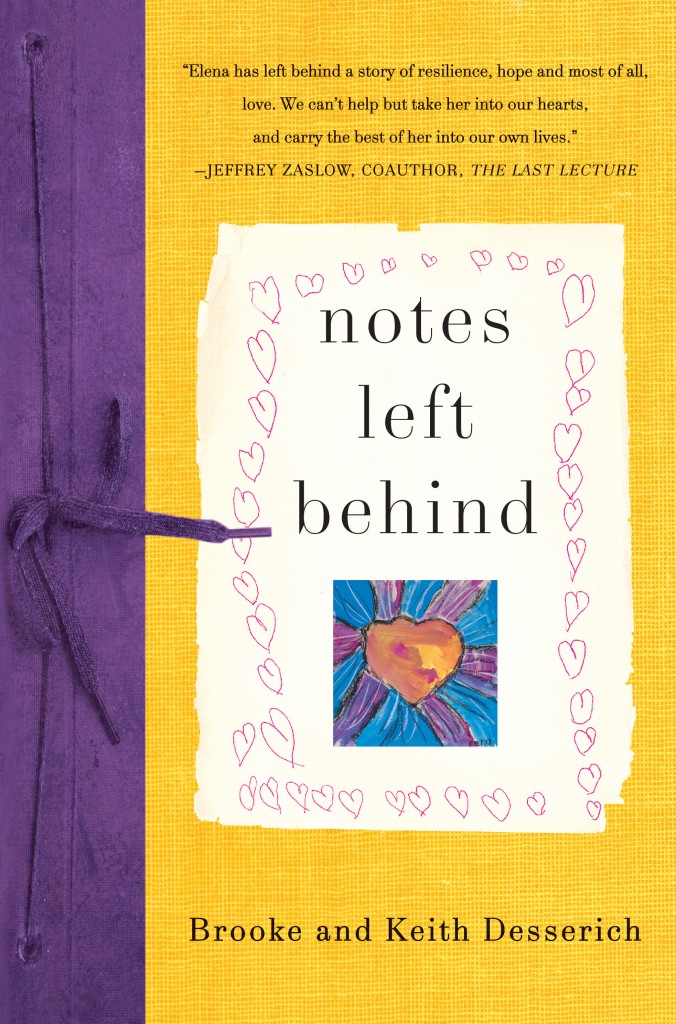 Notes Left Behind is a collection of journal entries written by Elena’s parents, Brooke and Keith Desserich. What began as a preservation of memories to share with Elena’s sister Gracie quickly became more meaningful to both the Desseriches and all those who cared about Elena.
The Desseriches chronicle their letters by the date and the number of days since diagnosis, the day Elena was given an estimate of 135 days to live. Brooke and Keith take turns writing entries that coalesce to provide a more holistic, parental view of caring for a child with cancer and her sibling.
While Elena wrote many notes to her loved ones, “this book too is a note from Elena, messages from a little girl who taught our family so much about life” (xiv). Elena’s sweet, sincere personality shines through the eyes of her parents, who share with us her experiences in losing her voice, gaining weight from steroids, and wanting nothing more than to be normal once more.
In the face of cancer, questions emerge about the daunting uncertainties and the forgotten nuances. Keith grapples with these question marks and calls out our band-aids, noting that “cures don’t come on toy shelves and they don’t have tags” (64). He reminds us that these material objects are powerful yet insufficient when lives are still at stake. It’s refreshing to remember that at the root of each childhood cancer is a need for a cure.
Inspired by their personal experiences with the incurable, the Desseriches started the organization The Cure Starts Now. With an emphasis on finding a cure for brain cancer, this organization believes that a cure for all cancers can be found in this elusive disease. Elena has touched the lives of those around her and more.
She has left behind more than notes.
Godzilla stands next to a purple hospital, breathing out engulfing flames of fire. He is burning out cancer.
This drawing was one of many to inspire art therapist Lisa Murray to share the work of children with cancer. Photographer Billy Howard is also dedicated to these children, capturing their personalities through a camera lens. Together, Murray and Howard set out to bridge their representations of these children. Murray let children illustrate what it feels like to have cancer through the medium of their choice, then wrote out their explanations. Howard photographed each child individually, honoring their personal journeys with cancer.
 Godzilla vs. Cancer was an art gallery exhibition in 1994, sharing the illustrations, explanations, and photographs of 25 children with a larger audience outside the Pediatric Oncology ward. Eight years later in 2002, 17 of the children had survived. These creations along with biographies and a list of resources were compiled to create the book Angels & Monsters: A child’s eye view of cancer.
Cancer brings out fear: tears, pain, sickness, confusion, isolation, and band-aids. But it also brings out friendships, faith, perspective, and love. While each artistic piece offers insight into each child’s perspective, black and white photographs showcase each child’s self. On a swing, with a superhero cape, by a window, curled in a bed. Each work of art and the rationale behind it is compelling, each photograph and each child beautiful.
The authors reflect honestly with simple yet profound understandings of these children and their journeys. I loved the phrase that Jeff Foxworthy uses in the forward to describe these children: “old souls in little bodies” (viii). These individuals exhibit the precision of language as they carve out childhood cancer. They invite us to into “a special world. No artifice exists there. The human spirit holds sway with complete honesty and great dignity” (6).
On the brink of graduation and a Broadway career, cancer threatened to take Alex Kip’s voice and his life. Two years later, Kip has held on to both, and he is sharing his story through theatre.
My Other Voice is a play written by Kip about his personal experiences as a young adult with cancer, starring Kip himself. Upon diagnosis, his mind was set on recovering in time for the “silly” senior showcase that doctors didn’t understand. When Dr. Foster asks Kip’s mom to break it to him that he would not be able to participate, this responsibility lingers; when it finally reaches Kip, he becomes distraught and untrusting. Interactions with the medical realm conveyed an arousing critique, calling for greater sensitivity in medicine. For respecting what patients value most in their lives and appreciating these needs whenever possible.
Kip experiences the destruction and recreation of identity as he loses his singing voice and finds a new one. As a patient, he loses independence and his sense of control as he is forbidden to work out. Cancer’s disruptive nature into Kip’s life as well as those around him is brought to life by the realness of each character. Each person responds to Kip’s cancer differently, physically and emotionally. Their actions and coping mechanisms vary, and getting to know these nuanced personalities and witness their transformations was a resounding effect of the play. The personal nature of illness as it permeates into lives is performed.
With the intimacy of the thrust stage, the audience is immersed in the performance. With young adult dialect, iMessages, and popular rap music, we enter into the college life. We even follow Kip and his friends as they get high off magic brownies infused with marijuana. Amidst the devastation of cancer, Kip finds friendship in a fellow cancer patient. Amy redefines what it means to have cancer, explaining that “You’re a survivor the day you start fighting.” While she herself does not survive in the traditional sense, her voice remains influential to Kip. Amy’s death illuminates the emotional depth to cancer, the disease reasserting itself as a threat to vitality.
Following the performance was a talk-back session led by Dr. Ora Pescovitz, the CEO of the U of M Health System. Through an interactive conversation with performers and audience members, some of the ideas introduced by the play were given voice. The discussion revolved around the controversy of medical marijuana, critiques about the medical profession, and value for artistic therapies in patient care. I asked Kip a question of my own:
How did the experience of retroactively narrating through play differ from writing a Caring Bridge blog throughout treatment?
Kip noted how the therapeutic process of writing began to substitute for his lost voice. He explained that in adapting his story to play form, he referred to his Caring Bridge posts and some of his private journal entries. These helped him to reconsider the disturbing, to remember the forgotten. “When I was sitting in the hospital I realized that I could use my gifts to make a different in the fight against “cancer” (UM Cancer Center interview with Kip).
Kip demonstrates how everyone can play a role in the illnesses experience. The play may conclude with Kip singing alongside his loved ones, but his revitalized voice continues to resound.
Healing is an intimate process, both for those being healed and for their healers. I choreographed this dance to the song Fix You by Coldplay to commemorate the intricacies of the healing process, particularly for those surrounding the sufferer. Illness may isolate the self, but it can often unite others.
From family and friends, physicians and nurses, therapists and chaplains, there are numerous individuals who dedicate themselves to this cause: to “try[ing] to fix you.” This performance honors these individuals, recognizing their independent contributions. It illuminates the parallels across these different efforts, revealing how these different methods of healing are in fact synchronized. Similar motions are performed with unique takes by each dancer and each healer. Reducing pain with Oxycodone, alleviating emotional unraveling through art. Finding solace in spirituality.
Healing is a collective effort, just as dancing; collaboration demands a conversation of sorts that is embodied here in movement. Each must share their insight and showcase their strengths while recognizing what to forfeit in favor of healing the mind, the body, and the total self. Considering the nutritional imbalances imposed by antidepressants, the psychological side effects of surgical disfigurement. The limitations to restoring normalcy.
There is dynamism to healing. There are trying times and moments of liberation, symbolized by movements high and low. There are bursts of chaos and body rolls, unexpected outcomes and relapses, but there are also breaths of peace demonstrated by graceful releases of the body and sustained poses. Recoveries.
This choreography and its performance demonstrate that healing vitalizes all involved, as it “ignite[s] your bones.”
Filed under Dance
Rooted in the essence of humanity, health and medicine are inherently interdisciplinary. How are these fields intertwined with others? We express this entanglement through prepositions, mumbled words that can resound with significance.
Take, for example, literature. We can consider literature in/and/of medicine. There is a prepositional choice that we can make, one that urges us to consider the angle of our approach. We can do the same with other media forms like art.
In: Medical literature is present in medical education lectures, in research publications, in patient charts. Medicine has established an entirely different language with its own terminology, one that can manifest itself as a form of literature through scientific writing. The clinical practice of medicine is a dialogic exchange, a narrative. My understanding is that this area of study is largely encompassed by the field of Narrative Medicine, one that notes the literary merit of the medical practice.
Of: Literature has long been fascinated in the practice of medicine, its accomplishments and its qualms. There have been writings about medicine for centuries. Some are the stories of medical practitioners like William Carlos Williams, Oliver Sacks, Danielle Ofri. And others are written about the medical sphere from afar, such as the works of Ken Kesey, Elizabeth Moon, Sinclair Lewis. These literary texts seem to be the focus of Medical Humanities, which explores medicine through a literary lens.
And: I claim that this blog explores the intersection of literature and medicine: the ‘and.’ This intersection, however, is certainly a grey area. The ‘and’ balances the two fields, literature and medicine, declaring them as separate studies equal in merit. This introduces the idea that perhaps, because these are distinct, each has something to learn from the other. Maybe scholars can develop reading, writing, and critical thinking skills by confronting the medical profession through literature. Or analyzing literature can instill in health care professionals a different kind of care and compassion. The former feels more like Medical Humanities, the latter Narrative Medicine.
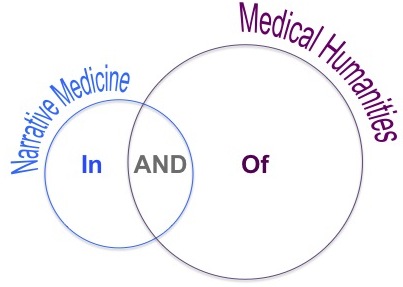
I believe that this is the realm shared by both Medical Humanities and Narrative Medicine. I’ve found that this grey area can be largely open to interpretation, but only through dissecting the fundamental threads within can we make sense of these fields and assemble these perspectives together.
Filed under Narrative Medicine Research
140 characters has never sounded like enough to me.
But for Scott Simon, Twitter has become a concise space for reflection and reverence of his mother’s last hours in the ICU.
When I first heard about this spectacle, I was slightly appalled about the idea of invading the intimate and private space of the ICU with social media. But this article approached these tweets from a different perspective, suggesting instead that this embodies a more modern form of mourning. “The brevity and sequentiality of Twitter eerily evokes the reality of time, allowing us to witness an event” (O’Rourke).
As fascinating as this correlation between time and social media is, I believe that this statement is more eery to me than what it proposes. Perhaps it is my personal aversion from Twitter, but I disagree: Twitter may give us a peek, but it does not enable our entire observation.
Heart rate dropping. Heart dropping.
— Scott Simon (@nprscottsimon) July 29, 2013
The heavens over Chicago have opened and Patricia Lyons Simon Newman has stepped onstage.
— Scott Simon (@nprscottsimon) July 30, 2013
She will make the face of heaven shine so fine that all the world will be in love with night.
— Scott Simon (@nprscottsimon) July 30, 2013
Thank you for all yr warm wishes and prayers. Such love drives the world.
— Scott Simon (@nprscottsimon) July 30, 2013
These tweets do not allow us to observe her death and its surroundings. We do not hear her breaths cease while the ICU continues to beep. We do not watch stillness set in.
What I found to be unsettling was not the tweets themselves but rather the act of tweeting. It seems as though Twitter served as an outlet and a means of communication for Simon during his mother’s time in the ICU, a coping mechanism of sorts. I respect Simon’s choice to share his ICU experiences through Twitter. But even in 30 minutes after his mother’s death, Simon sent 3 tweets. Which means that he spent some time, maybe just a minute or so, looking at a screen and typing rather than being totally present with the loved ones around him.
It is inevitable that social media has become a space to share not only the joys and triumphs of life but also its trials and fumblings. But I wonder if this is the inherent trap to social media that we must recognize- it can become an obligation to others that draws us from the people physically around us. And with all the publicity that this happening has attracted, I was surprised to see how much of the attention has been centered around Scott Simon.
I guess I just wish that at the moment of her death, there had been more attention drawn to the person at the center of these tweets: his mother, Patricia Lyon Simon Newman.
Filed under Literary Narratives, Miscellaneous Musings, Voice
Sometimes the tendency to wear your heart on your sleeve, to openly express your emotions, can be suffocated by the medical profession. But wearing your heart on your back is becoming increasingly appreciated.
The Walking Gallery is “the Gallery that walks. The Patients that wear our stories on our back” (Holliday).

Image courtesy of Ted Eytan under a Creative Commons license: BY-SA.
It’s this revolutionary idea that art can provide a window into the patient experience, one that can be displayed by the clothes on a person’s back. This offers mobility to art, a method of transportation that escapes the confinements of wall hangings and pervades into inevitable lines of vision. This increased accessibility allows “patients,” as embodied by this artwork, to enter into places and discussions that they have never before been a part of. Now, patient experiences can be visible and actively remembered in the decision spaces that often influence but do not include patients.

Image courtesy of Ted Eytan under a Creative Commons license: BY-SA.
The work of Regina Holliday, the artist who brought this exhibit of sorts to life, is inspirational. She not only has a way with art, but also a way with language: her overwhelmingly powerful talk at Stanford incredibly moved me, and she has piqued my interest in exploring the place of art in medicine. Holliday is one of the first artists that I’ve come across in the field of patient advocacy, and her creations have gathered incredible force for this movement.
What I love about the Walking Gallery is that it takes a step forward to putting a story to the patient experience. These jackets and the images that they bear evoke emotions buried within medicine. And The Walking Gallery is not limited to patients: physicians, policy makers, and others associated with health care all have stories to share. Despite the distinct roles in medicine, art overcomes these boundaries with brushstrokes and splashes of color. We can wear our experiences, the good and the bad and the in-between, the joys and sorrows, the triumphs and trials. Boldly.
Filed under Visualizing Illness


 Investigating Illness Narratives