Monthly Archives: February 2013

Healing Wounds in David Small’s Stitches

After attending the Tell Me A Story Symposium last week that highlighted the powerful place of illustrations in storytelling, I was able to take a step back and approach David Small’s graphic novel Stitches with a more open mind. In this memoir, Small takes the reader leaping from memory to memory. He introduces his nuclear family, which consists of an overbearing to the point of violent father, a stern but silent mother, and a drumming brother. From the story’s beginning at six years of age, there is something off about Small, and his father aims to rectify his son’s character. Small recalls spending time with his abusive grandmother and the traumatizing experiences he endured both physically and mentally. Flash forward: eleven years of age. Small’s growth is discovered, but the family responds in denial and neglect. His mother initially fears the doctor’s bills more than the growth itself, and the doctor’s reassurance that it is no cause for alarm allows it to fall lower and lower on the family’s priorities. Finally, Small has not one but two surgeries; while he entered the hospital with a additional growth on his neck, he emerges with a vacancy of vocal cords replaced by nothing but stitches. Confused, Small eventually discovers that his condition had a name: cancer. His parents had chosen to keep the identity of his illness confidential from him.

Although Small’s stitches may remain in tact, his wounds reside much deeper than the surface of the skin. His life begins to unravel until a therapist, the white rabbit, opens up a space for communication that provides him with relief and allows him to address the inherent tensions with his family. As Small improves mentally, these tensions begin to take their toll on the family as his grandmother is sent to an asylum and he encounters his mother engaging in a lesbian act.  His father pulls him aside, finally admitting that Small’s cancer was a result of his own father’s radiation experimentation in his childhood. At sixteen Small is out making a name for himself as an artist, when a call informs him that his mother is dying. He visits her on her death bed, powerfully resting his hand on hers as a sign of peace.

As the first illness narrative that I have encountered in the form of a graphic novel, I found the illustrations to be particularly gripping. Not only did they really bring to life Small’s tale, especially since he hints at his artistic aspirations in the story, but also because images hold a different kind of power than words. Small’s depiction of his voiceless life was intriguing. I was also fascinated by the intertextuality of the Alice in Wonderland story and the White Rabbit’s guest appearance as a therapist. By coupling powerful language with jarring imagery, Small achieves an evocative graphic novel memoir that moves readers beyond typical limits.

Discussion Questions:

  1. What did the genre of graphic novel bring to this illness narrative?
  2. How might the genre of graphic novel affect the audience of this tale? Under what circumstances might this be a more effective medium than other genres?
  3. What were some moments when images resonated and were more powerful than their linguistic counterparts may have been?

 

1 Comment

Filed under Independent Study, Literary Narratives, Visualizing Illness

Rethinking a MMT of Cancer Survival

Today I came across the following on one of my favorite sites, makesmethink.com (MMT):

“Today, on my mom’s side of the family, the majority of the women have had breast cancer – many of them multiple times. But none of them have died from it. The amazing beauty and strength of the women in my family MMT.”   -Sandy

Instinctively, I can’t help but scrunch my eyebrows at this one. While I agree that it is a truly wonderful thing for Sandy’s family to have been blessed by survival, I think that the construction of her idea gives off the wrong idea and falls victim to the temptations of the triumph narrative.

Sandy draws a direct link between the survival of these women, their external appearance, and their inner strength. She paints the image of a group of attractive women whose strength allowed them to beat the odds and conquer cancer. She claims that it is these characteristics of these individuals that “makes me think.” My question is, what is the correlation between these characteristics and their successful evasion of death?

This also seems to undermine the experience of all the women who don’t survive breast cancer; does this mean that those who don’t survive did not have enough will to live?

It’s quite possible that I am entirely overthinking this, but I think that this exemplifies the importance of language as an expression of our understandings of illness. While language can be incredibly empowering, there are times when it can have subtle implications unbeknownst to us.

Leave a comment

Filed under Literary Narratives, Miscellaneous Musings

Catalyzing Change With Narrative

Standing before us were four individuals: a public health professor, a director, an actor, an artist. But each of these individuals held so much more than just one profession; they each dabbled into a variety of other realms, but they were all here for one reason. Today, they were here to promote the power of narrative.

Tell Me A Story: Designing Narratives for Health Behavior Change was an extraordinarily compelling and fascinating symposium organized by the School of Public Health.

Tell Me A Story

With three prominent guest speakers each contributing their insight about a different facet of the narrative, this symposium explored essence of the narrative and the potential potency of its role in instigating change.

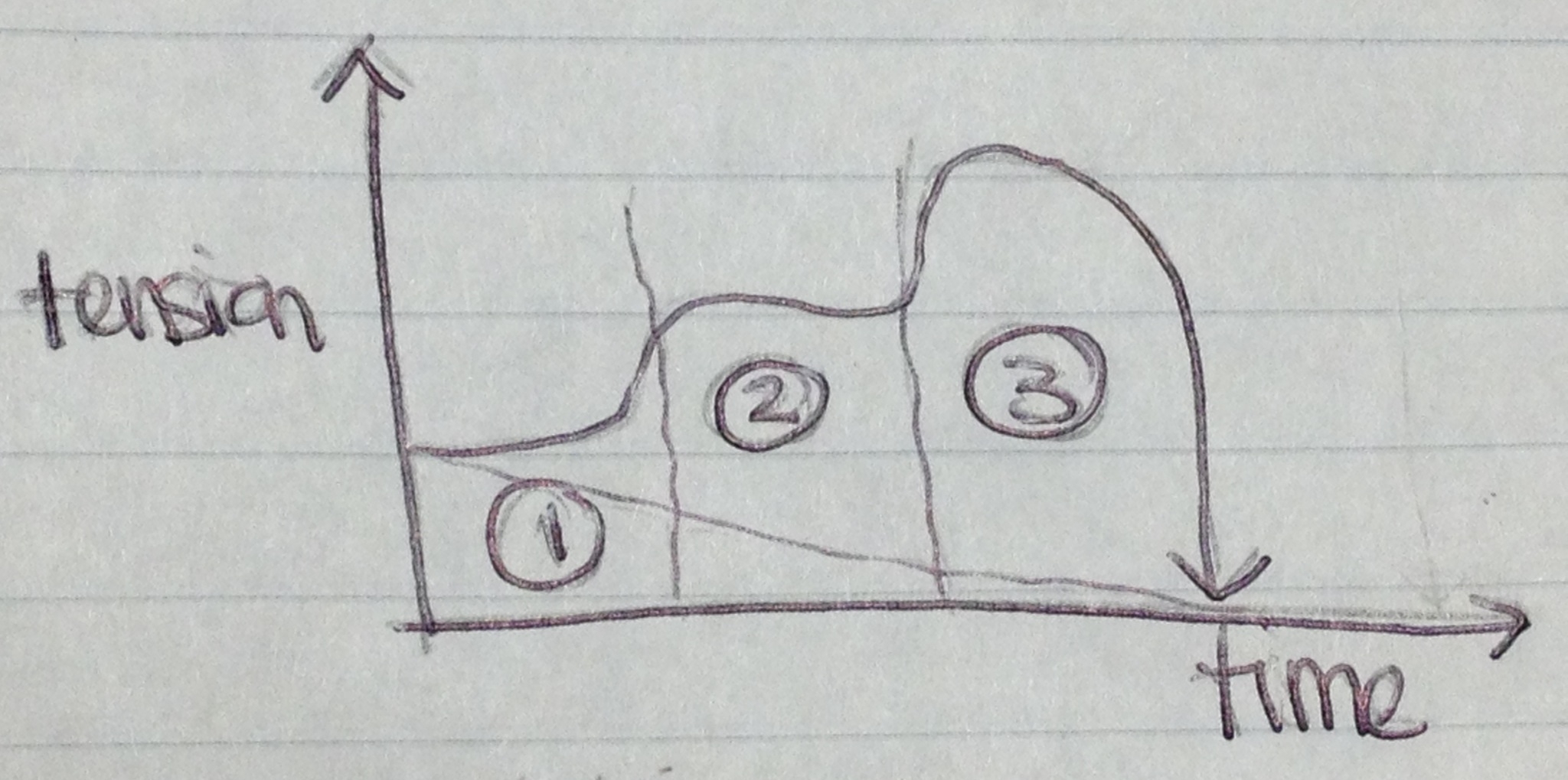
To begin with, Monte Montgomery showed the audience what makes a story. 4 purposes, often accomplished by a 3 act structure. Engaging, understandable, and memorable all lead to the fourth purpose: actionable. The 3 act structure, as illustrated below.

3 Act Structure

Although this 3 act structure seems to be relatively pervasive in our society, I found it interesting that illness narratives represent one of the few genres that often defy this standard. Just as disease pushes against the normal functioning of the body, illness is defined by a deviation from the norm. And since illness narratives are created to mirror the illness experience, illness narratives resists the 3 act structure.

So what are the effects of this resistance? The most powerful deviation in my mind was that while 3 act narratives imply that conflict allows for an individual to achieve greater stability. This in many ways embodies the triumph narrative, which Conway so persistently cautioned us about. The 3 act structure suggests that the restitution narrative allows for not only a restoration but a progression, where an individual becomes better off than they were in the past. Illness narratives that break free from the model of the triumphant overcome of illness, then, also escape the confinement of the 3 act structure.

After Montgomery had established a basic understanding of narrative and explored the individual change that narratives can inspire, Mike Mosallam discussed the social changes that can arise from narratives. Leading with the powerful question “What is my story?,” Mosallam gave us a glimpse of his own narrative and introduced us to his reality TV show All American Muslim to show how theater can instigate social change by creating dialogue, building bridges, and humanizing groups of people such as Arabs/Muslims.

One story that particularly struck me was Mosallam’s anecdote about acting as a patient for medical school students. Mosallam described how a key part of using narrative revolves around preserving the “authenticity of stories.” There were some medical students who he said he would never want to have as his doctor. “You can’t guide and manipulate,” he explained. “Let the subject direct the narrative.”

Taking a step away from the commonly linguistic nature of narrative, Kody Chamberlain walked us through the process and the power of incorporating art into narrative. He opened my mind to thinking more about what is entailed by the creative process, which is really an interdisciplinary challenge that shares many similarities between different realms. It was fascinating to think about the impact of images, especially in the spaces between words or as replacements to words. Chamberlain’s advice about the creative process, the persistence and the depth involved in works of art, was extremely interesting, and I felt like he dispelled many common stereotypes of art with ideas such as “inspiration is a placebo.”

These three speakers left us all with a challenge:

What do you want to do? How do you want to do it?

And how can you incorporate the power of narrative?

1 Comment

Filed under Miscellaneous Musings

The Closing of the Bell Jar

While the first half of The Bell Jar introduces the reader to the character of Esther and the world she inhabits, the second half truly allows the reader to witness firsthand how Esther’s mind unravels as depression takes its toll on her. Esther meets Dr. Gordon, who insists on administering shock therapy when talking results in no improvements. The experience of shock therapy feels like slumber when done correctly, but Esther’s consciousness during parts of the shock therapy leaves her traumatized despite her external appearance of recovery.

Life goes on, but Esther’s depression lingers as she is consumed by suicidal thoughts. She contemplates and half-plans a variety of attempts: cutting herself in the bathtub with a razor blade, drowning in the depths of the sea, hanging herself with her mother’s bathrobe drawstring. She becomes aware of her body’s physiological desire to live, and its resistance to her suicide attempts. Finally, she finds her answer in her mother’s sleeping pills, and she overdoses within the comfortable confines of the cellar.

Miraculously, her groans give away her hiding spot and Esther’s mother finds her. She is initially admitted to the state hospital, but her sponsor Philomena Guinea has her transferred to a better private hospital. While taking insulin injections, Esther spends time with Valerie and Miss Norris before Joan, the girl that Buddy once took to a school dance, is admitted as well. She establishes a good relationship with Dr. Nolan, and gets moved up to Belsize with Joan, the final step before she reenters the real world. Although Dr. Nolan had initially assured her that she would not have to receive any more shock treatment, Dr. Nolan stands by Esther’s side and makes sure that it is done properly.

As winter semester draws nearer, Esther seems to be doing better. She gets fitted for birth control and loses her virginity to a professor named Irwin, but she feels pain rather than pleasure and bleeds tremendously. Joan helps her to the hospital, but this emergency seems to traumatize Joan for she hangs herself just a few days after. The novel draws abruptly to a close, just as Esther enters into a room full of doctors to demonstrate her readiness for restitution.

Although I knew that this was a book about mental illness, the intensity of Plath’s writing and the pain of experiencing Esther’s suicidal thoughts took me aback. My experiences of reading the novel in many ways seemed to parallel Esther’s experiences of coping with mental illness as embodied by the metaphor of the bell jar. There were times, particularly as she described her elaborate suicide schemes, where I felt as though a bell jar was enclosing around me. I was overwhelmed by the naked honesty and bold vulnerability of Esther (or Plath, if interpreted autobiographically) as she exposed her mind in such an unhindered way. Interspersed amongst these painful passages of depression were moments when Esther was doing better, and it was at these times that her personality shined through, other aspects of her character came to life, and I could feel the bell jar lift from around me. This speaks to Plath’s incredible success at capturing her experiences and illuminating mental illness by carefully crafting language.

Discussion Questions:

  1. How does Esther’s depression manifest itself in the writing style of the second half of the novel?
  2. What is the role of supporting characters, particularly other psychiatric patients, in exposing the psychiatric ward? How do these interactions influence Esther?
  3. How does viewing the novel through an autobiographical lens illuminate certain aspects of the plot and the language and eclipse others? An illness narrative lens?

Leave a comment

Filed under Independent Study, Literary Narratives

Remembering Sylvia Plath: 50 Years Since the Suicide

Fifty years ago today, Sylvia Plath locked all the doors. She kept her children safely in the next room, using towels to seal the empty spaces that still connected her to them. She turned on the gas stove. She reached her head into the darkness, breathing deeply. Exhaling life, inhaling death.

Until about a week ago, Sylvia Plath was just a name to me, a famous poet who’s tragedy I had forgotten. Now, I can’t stop thinking about her. Learning about the kind of person she was, the struggles that she faced, the ways she thought, has in many ways changed my own thoughts. There’s something about her and about her tragic, eery story that has granted her a sense of immortality.

I remember reading Plath’s poem Daddy in high school. I don’t remember when, I don’t remember the class or the teacher, I don’t even remember what we discussed. But I remember her voice. Rereading the poem, I can still hear Plath’s voice, the rise and fall of her words as they tumble off her tongue, her sharp pronunciation of words like daddy.

Plath’s ambitious love for language. Her persistent drive despite publication rejections. Her internal challenges with mental illness. The highs and the lows of her marriage to Ted Hughes. Her suicide, both her attempts and her success. The cascade of suicides that followed in suit over the years– Hughes’ second wife, who followed Plath’s methods; Nicholas Hughes, her son. I am both intrigued and torn by the mystery of Plath’s life. I’ll be discussing my thoughts and admirations of The Bell Jar, a somewhat autobiographical account of her experiences with mental illness,  later this week. .

Three years ago, around this time of the year, I wrote about the immortality of The Catcher in the Rye in honor of J.D. Salinger’s death. Two years ago, I wrote about the importance of commemorating poets in honor of Elizabeth Bishop’s 100th birthday. Now, I am writing in about the powerful resonance of Sylvia Plath in honor of the 50th anniversary of her suicide.

I am honoring her life today, on the day that she that she ended it.

Sylvia Plath's grave

Photo by Anosmia. CC:BY.

Leave a comment

Filed under Miscellaneous Musings

Entering the Mind of Esther: Plath’s The Bell Jar

In Sylvia Plath’s The Bell Jar, the reader enters into the mind of Esther Greenwood, an Honors English student who works in fashion and an aspiring poet studying in New York. Living in the Amazon hotel with other college girls, she has many adventures from going out with Doreen to getting food poisoning from a food tasting event. Esther is a hard worker who has no dreams of getting married, and she enjoys going out on dates and meeting men with unique names.

We learn about Buddy Wilkins, the man who was once her love interest; now that he loves her in return, she has unearthed his flaws of hypocrisy and is no longer interested. Their relationship grows as Buddy introduces her to the life of a medical student and she exposes him to the world of poetry. He admits to her that he has known one other woman, and this knowledge makes Esther feel inexperienced and uncomfortable with his innocent façade. Illness brings their accelerating relationship to a halt: Buddy has TB and is sent to a clinic in the mountains.

When Esther accompanies his father to go visit him, Buddy proposes to her. Esther denies him, claiming that marriage is not her plan and using her neuroticism as a scapegoat. Buddy, however, insists persistently in being with her, and the conversation lingers. He takes her skiing for the first time and she breaks her leg.

Time jumps forward, and Esther is heading home for the summer, eagerly awaiting her acceptance into a summer writing program at Boston. She had been confident and expectant about the course, and the news that she has been rejected is earth shattering to her. She is trapped at home, and she struggles to escape the tragedies of her situation by fantasizing about the future. Things take their toll on her, and her inability to sleep or read leads her to the family doctor; she refers Esther to a psychiatrist.

Discussion Questions:

1.     How does the disjointed dimension of time illuminate the narrator, Esther?

2.     Through the juxtaposition of Esther’s passion for poetry and Buddy’s interest in medicine, what does Plath reveal about the intersection of these fields?

3.     How do metaphors and similes function in this narrative? How do they enhance or complicate the reader’s understanding?

Leave a comment

Filed under Independent Study, Literary Narratives