Today I came across the following on one of my favorite sites, makesmethink.com (MMT):
“Today, on my mom’s side of the family, the majority of the women have had breast cancer – many of them multiple times. But none of them have died from it. The amazing beauty and strength of the women in my family MMT.” -Sandy
Instinctively, I can’t help but scrunch my eyebrows at this one. While I agree that it is a truly wonderful thing for Sandy’s family to have been blessed by survival, I think that the construction of her idea gives off the wrong idea and falls victim to the temptations of the triumph narrative.
Sandy draws a direct link between the survival of these women, their external appearance, and their inner strength. She paints the image of a group of attractive women whose strength allowed them to beat the odds and conquer cancer. She claims that it is these characteristics of these individuals that “makes me think.” My question is, what is the correlation between these characteristics and their successful evasion of death?
This also seems to undermine the experience of all the women who don’t survive breast cancer; does this mean that those who don’t survive did not have enough will to live?
It’s quite possible that I am entirely overthinking this, but I think that this exemplifies the importance of language as an expression of our understandings of illness. While language can be incredibly empowering, there are times when it can have subtle implications unbeknownst to us.
Standing before us were four individuals: a public health professor, a director, an actor, an artist. But each of these individuals held so much more than just one profession; they each dabbled into a variety of other realms, but they were all here for one reason. Today, they were here to promote the power of narrative.
With three prominent guest speakers each contributing their insight about a different facet of the narrative, this symposium explored essence of the narrative and the potential potency of its role in instigating change.
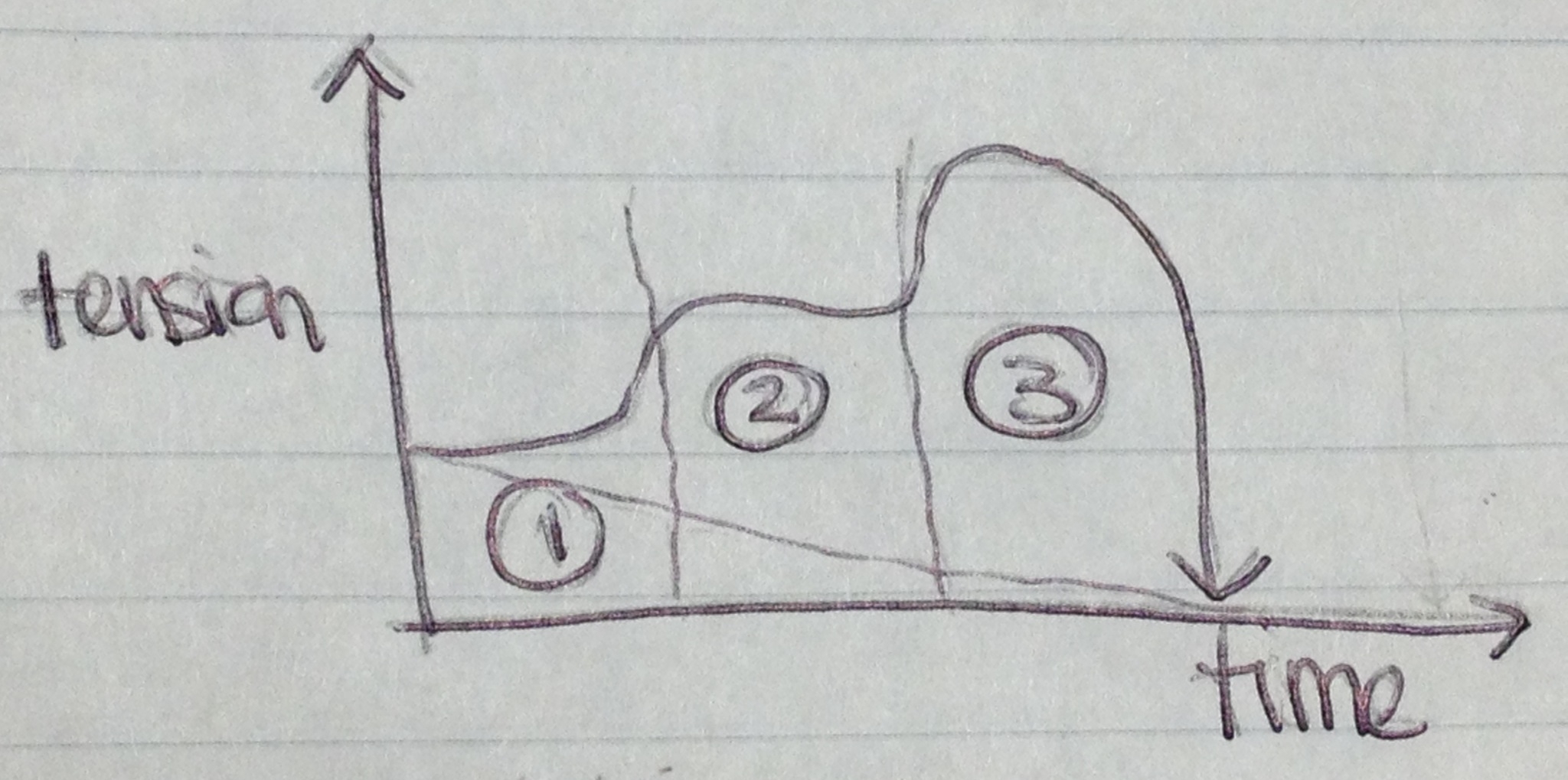
To begin with, Monte Montgomery showed the audience what makes a story. 4 purposes, often accomplished by a 3 act structure. Engaging, understandable, and memorable all lead to the fourth purpose: actionable. The 3 act structure, as illustrated below.
Although this 3 act structure seems to be relatively pervasive in our society, I found it interesting that illness narratives represent one of the few genres that often defy this standard. Just as disease pushes against the normal functioning of the body, illness is defined by a deviation from the norm. And since illness narratives are created to mirror the illness experience, illness narratives resists the 3 act structure.
So what are the effects of this resistance? The most powerful deviation in my mind was that while 3 act narratives imply that conflict allows for an individual to achieve greater stability. This in many ways embodies the triumph narrative, which Conway so persistently cautioned us about. The 3 act structure suggests that the restitution narrative allows for not only a restoration but a progression, where an individual becomes better off than they were in the past. Illness narratives that break free from the model of the triumphant overcome of illness, then, also escape the confinement of the 3 act structure.
After Montgomery had established a basic understanding of narrative and explored the individual change that narratives can inspire, Mike Mosallam discussed the social changes that can arise from narratives. Leading with the powerful question “What is my story?,” Mosallam gave us a glimpse of his own narrative and introduced us to his reality TV show All American Muslim to show how theater can instigate social change by creating dialogue, building bridges, and humanizing groups of people such as Arabs/Muslims.
One story that particularly struck me was Mosallam’s anecdote about acting as a patient for medical school students. Mosallam described how a key part of using narrative revolves around preserving the “authenticity of stories.” There were some medical students who he said he would never want to have as his doctor. “You can’t guide and manipulate,” he explained. “Let the subject direct the narrative.”
Taking a step away from the commonly linguistic nature of narrative, Kody Chamberlain walked us through the process and the power of incorporating art into narrative. He opened my mind to thinking more about what is entailed by the creative process, which is really an interdisciplinary challenge that shares many similarities between different realms. It was fascinating to think about the impact of images, especially in the spaces between words or as replacements to words. Chamberlain’s advice about the creative process, the persistence and the depth involved in works of art, was extremely interesting, and I felt like he dispelled many common stereotypes of art with ideas such as “inspiration is a placebo.”
These three speakers left us all with a challenge:
What do you want to do? How do you want to do it?
And how can you incorporate the power of narrative?
Fifty years ago today, Sylvia Plath locked all the doors. She kept her children safely in the next room, using towels to seal the empty spaces that still connected her to them. She turned on the gas stove. She reached her head into the darkness, breathing deeply. Exhaling life, inhaling death.
Until about a week ago, Sylvia Plath was just a name to me, a famous poet who’s tragedy I had forgotten. Now, I can’t stop thinking about her. Learning about the kind of person she was, the struggles that she faced, the ways she thought, has in many ways changed my own thoughts. There’s something about her and about her tragic, eery story that has granted her a sense of immortality.
I remember reading Plath’s poem Daddyin high school. I don’t remember when, I don’t remember the class or the teacher, I don’t even remember what we discussed. But I remember her voice. Rereading the poem, I can still hear Plath’s voice, the rise and fall of her words as they tumble off her tongue, her sharp pronunciation of words like daddy.
Plath’s ambitious love for language. Her persistent drive despite publication rejections. Her internal challenges with mental illness. The highs and the lows of her marriage to Ted Hughes. Her suicide, both her attempts and her success. The cascade of suicides that followed in suit over the years– Hughes’ second wife, who followed Plath’s methods; Nicholas Hughes, her son. I am both intrigued and torn by the mystery of Plath’s life. I’ll be discussing my thoughts and admirations of The Bell Jar, a somewhat autobiographical account of her experiences with mental illness, later this week. .
Three years ago, around this time of the year, I wrote about the immortality of The Catcher in the Rye in honor of J.D. Salinger’s death. Two years ago, I wrote about the importance of commemorating poets in honor of Elizabeth Bishop’s 100th birthday. Now, I am writing in about the powerful resonance of Sylvia Plath in honor of the 50th anniversary of her suicide.
I am honoring her life today, on the day that she that she ended it.
The entire auditorium was silent as eyes followed the words on the screen and absorbed the image of the patient in a hospital room. These moments of patient narratives were interspersed throughout Dr. Carmen Green’s presentation today (the 50th anniversary of the “I have a dream” speech) at the Martin Luther King, Jr. Symposium organized by the Health Sciences Program at the University of Michigan. People from all across campus, from the schools of medicine, dentistry, public health, pharmacy, etc., had all gathered to learn more about “Unequal Burdens and Unparalleled Opportunities: Achieving the Dream for Health and Pain Care Equity.”
Dr. Green is an accomplished woman, a Professor of Anesthesiology, Obstetrics and Gynecology, and Health Management Policy. Her passion and interest in addressing health inequalities was incredibly inspiring. Throughout her presentation, she balanced her personal experiences with shocking facts about American health care and disparities in treatment.
In addition, Dr. Green acknowledged the importance of listening and storytelling in health care. She admired “the power of narrative to embrace the art and science of medicine,” to transform it. It was exciting to see her advocate on behalf of this communication through language, because it helped bring to life some of the theories that I have been reading about. She demonstrated that narratives are indeed giving patients a voice, and slowly but surely, more and more physicians are listening.
Her take-home message about narratives was that “we need to be able to listen actively, not passively.” This distinction stands up agains the common practice of failing to be engaged in conversation with patients. This means to pay close attention to the patient as a whole, the patient’s body language, the patient’s disposition, the patient’s praises, the patient’s complaints. Not only hearing everything that a patient says, but also responding to the patient. Failure to do so undermines the patient (this reminded me of Oliver Sacks’ A Leg to Stand On, which I haven’t read yet but Frank’s novel makes me feel as though I have). Particularly in regards to addressing pain inequity, I think that understanding and reacting to narratives is crucial, and Dr. Green’s placement of narratives throughout her talk suggests that she agrees.
Dr. Green’s talk concluded powerfully with her own dreams for what the future will hold 50 years from now, in 2063. She remains optimistic about our future: “Our strength is in our diversity and in our ability to see through multiple lenses.”
To see through multiple lenses, to hear through multiple narratives.
First off, let me introduce myself. I’m Trisha Paul, a junior at the University of Michigan pursuing a B.S. in Honors English with a minor in Medical Anthropology. I hope to attend medical school and, eventually, become a Pediatric Oncologist.
I came to college with a fascination for medicine, a love for literature, and an uncertainty about how to pursue both. At the time, I figured that I could major in English in undergrad, then shift gears and head to medical school. Freshman year, however, showed me that these interests were not quite as different as I thought.
I remember reading a New York Times article about Abraham Verghese. I was so excited to see that I wasn’t the only one to share interests in medicine and in literature. I even emailed Dr. Verghese just to tell him how inspiring it was for me to read about his life, and that I have often felt the same way about how medicine and writing require “an infinite curiosity about other people.” I was pleasantly surprised to even get a response from him!
I started to come across other doctors like Perri Klass who shared an interest in literature. There’s even a wikipedia page about physician-writers. The more I learned about these individuals, the more I became convinced that there was a way for me to intertwine my interests in literature and medicine in my future career.
And that’s when I learned about the field of Narrative Medicine. A fellow pre-med English major told me about Columbia University’s Program in Narrative Medicine, which educates leaders who will “imbue patient care and professional education with the skills and values of narrative understanding.”
This program embodies exactly what I had hoped to do; it encourages an exploration of the “and” between literature and medicine. I began delving into this intersection through a number of works: Anne Fadiman’s The Spirit Catches You and You Fall Down, Abraham Verghese’s My Own Country, Susan Sontag‘s Illness as Metaphor, Siddhartha Mukherjee’s The Emperor of All Maladies, Rebecca Skloot’s The Life of Henrietta Lacks. The more I read, the more intrigued I become.
At the University of Michigan, there was even an English course offered that explored illness narratives with Howard Markel, another incredible physician-writer. I was eager to take the class and devastated when it was cancelled. Determined to still read the material, I emailed Alexandra Stern, the professor who co-taught the class in the past, with hopes of doing an independent study.
And thanks to Professor Stern’s enthusiasm, that’s what I’ll be doing this semester – studying Illness Narratives: Literature and Medicine. I’m so excited that this worked out, and I can’t wait to learn more about this fascinating body of literature. This blog will be a place for me to reflect about the works that I encounter, to struggle with the text and the ideas that I come across.
I look forward to continuing my investigations of illness narratives even after this semester. It’s a new year, and I’m excited about the new adventures that it brings.




 Investigating Illness Narratives