Tag Archives: Cancer

Block Out Cancer: Helping Children Tell Their Stories

C.S. Mott Children’s Hospital has a campaign for childhood cancer awareness month: Block Out Cancer. Block Out Cancer is “a rallying cry for people from all walks of life to come together to support the fight against children’s cancers.”

I’m honored that Mott has featured this blog post I wrote about my project:

My name is Trisha, and I help children tell their stories to Block Out Cancer.

mott-blog-BOC-thumb


Leave a comment

Filed under Chronicling Childhood Cancer: Illuminating the Illness Experience through Narrative, Literary Narratives

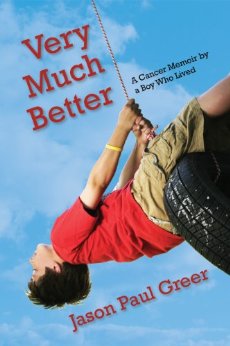
Very Much Better: A Survivor Reflects and Relives Childhood Cancer

“Cancer was everywhere. There was no moment, thought, idea, ache or pain, burst of energy or breathless moment that didn’t change, or wasn’t changed by my cancer– there was always a piece of it with me, somewhere, in something.” (67)

very much betterJason Greer’s memoir Very Much Better holds within it a piece of his cancer. Diagnosed with Ewing’s sarcoma on the brink of adolescence, Greer leaves behind his hometown in Montana for the Children’s Hospital in Seattle, Washington. But he finds strength in support from his loved ones, family and friends . For Greer, “faith…is the crying from inside the soul to plunge into living”; his beliefs energize him throughout his journey (117).

Greer smoothly melds his retroactive retelling of the past with “a look back” from his present point of view. We become familiar with Greer as an 11-year old boy and as a  grown-up adult, the during and the after of cancer, and we witness how the disease matures him hastily. He intersperses medical terms such as “pre-op” or “outpatient,” denoting their foreign nature by quotation marks (10;14). With witty chapter titles like “The Art of Throwing Up” and “The Cancer Patient’s Guide to Duct Tape,” personality and a sense of humor shine through each adventure (xi).

What struck me most about Greer’s memoir was his powerful grasp of his experiences. Particularly eloquent was his ability to capture one of the most emotional aspects of coping with childhood cancer: losing others to the disease. The deaths of Erik, Chad, and Jesse are each heart-wrenching in their own right, and Greer illuminates their important place within his own cancer experiences.

“Cancer threatened each of us, for a time was inescapable, and seemed to be everywhere. But as we sat in the company of each other’s encouragement, we surrounded the disease — and we defied it, every part of it” (83).

Leave a comment

Filed under Chronicling Childhood Cancer: Illuminating the Illness Experience through Narrative, Literary Narratives

Colonomic: Cancer, Pregnancy, and Comics

“You’ve got 3 options.

1. Have chemo now and risk damaging the baby

2. Abort the baby and start chemo after… I must make you aware that chemo might make you infertile

OR

3. Delay treatment until after it’s born.”

(Matilda Tristram, February Colonomic)

How does Matilda Tristram face these choices? With a black felt pen.

Colonomic is “an ongoing comic about it all.” As an 18-month pregnant woman, she was diagnosed with Stage IV Colon Cancer in February. With a passion for sketching and writing, Tristram has turned to comics as a means of communicating with loved ones about how she was doing.

The black and white nature of her comics gives them a sense of precision, and her concise use of language leaves a reader valuing the impact of each word.  The simplicity of her sketches sharpens them, and she distills each image to its core. Her authenticity and honesty is exposed by her unaltered writing and drawing, which preserves her presence within this work of art. Unsettled emotions of frustration surface, but so to does gratitude for the simple pleasures. Some moments are comical, others more tragic. 

The name Colonomic melds together the bodily organ with a form of art in a way that piques your interest, and exemplifies that these distinct realms may in fact be connected. This comic establishes an  incredible connection between the work of literature and art.

One thing I thought was interesting was that after watching Matilda’s story: A matter of life and death, the caption didn’t quite seem to fit.  The caption claims that “she has created a comic book that details the difficult decisions that came next: whether to undergo chemotherapy and whether to keep the baby” (Guardian). But Colonomic pushes against these decisions, drawing upon so many more of Matilda’s unique experiences.

Leave a comment

Filed under Literary Narratives, Visualizing Illness

One Week and Five Patients Later

It’s incredible when the long anticipated is greater than ever expected.

That’s how I feel about my thesis research. I’ve said this before, but I still can’t believe that it has come this far.

As an aspiring Pediatric Oncologist, the experience of interacting with the variety of health professionals in this realm is invaluable. But what I treasure most is the time that I have spent with each of my patients: the words exchanged, the deep inhalations, the glances away, the silences. In many ways, what cannot be captured naturally in front of a recorder are the things that I have held on to from these conversations.

The Pediatric Heme/Onc staff at Mott have all been so helpful and enthusiastic, the patients and their families kind and supportive. One of the things about volunteering with these patients for years is that not only do you never forget them, but they never forget you either. I was touched when a mother recognized me from my presence in the playroom over the years.

As I’ve begun to implement the research protocol that I designed, I’ve become grateful for the flexibility engrained in my project. Most children that I have worked with seem to prefer having a verbal conversation about their experiences before constructing their written stories, but that has not always been the case. And the age range for the study, 10-17 year olds, has proven to be more restricting than focusing. I think that to capture the spectrum of cancer diagnoses and effects, I will need to expand this to include children as young as 6 or as old as 21.

After we had completed the activity in its entirety, one patient told me that this was the most that he had ever spoken about cancer. And perhaps that is what I have been reaching for all along. As volunteers, we engage with these patients but never directly confront them about their diagnoses because that is not what is important. This activity allows me to explore  this unknown taboo, to dive in headfirst.

2 Comments

Filed under Chronicling Childhood Cancer: Illuminating the Illness Experience through Narrative

A Summer Reading List

A friend asked for suggestions for a booklist, so I figured I’d craft one here. This particular list focuses on historically contextualized texts and artistic representations.

Books for History of Medicine Enthusiasts:

1. The Emperor of All Maladies: A Biography of Cancer, Siddhartha Mukherjee

A comprehensive documentation of Cancer’s transformation over the years. Mukherjee skillfully weaves the narratives of patients, physicians, and researchers with the political, social, and scientific evolution of the disease.

2. The Immortal Life of Henrietta Lacks, Rebecca Skloot

A canonical work about the famous HeLa cells. Skloot digs deeper into the woman behind these immortal cervical cancer cells: Henrietta Lacks, who never knew that her cells were taken, grown, and sold without her consent. This book explores the racial inequities of health care in the US, and tells the story of the Lacks family and how they have been impacted by this experience.

3. The Spirit Catches You and You Fall Down, Anne Fadiman

Another canonical book in Medical Anthropology, one that provides a more cultural spin on health disparities. Fadiman tells the story of Lia Lee, a Hmong child in California, whose severe epilepsy illuminates the cultural clashes between her Hmong family and Western doctors.

4. Cutting for Stone, Abraham Verghese

A gripping piece of fiction that follows the story of the Stone family over the years. With a cultural backdrop of Addis Ababa, Ethiopia, and a focus on the art of surgery,the reader is immersed into a different realm of medicine. 

Books for Art of Medicine Enthusiasts:

5. Stitches, David Small

A potent graphic novel set in Detroit about how cancer physically stripped Small of his voice and its psychological effects. As a talented artist himself, Small uses imagery to fill in the spaces where language falls short.

6. The Diving Bell and the Butterfly (literature and film)

These works coupled together provide a good portrayal of Jean-Dominique Bauby’s experience with full body paralysis. I suggest reading the book before viewing the film to approach the viewing experience with a more authentic perspective.

Happy reading!

2 Comments

Filed under Miscellaneous Musings

Beating Breast Cancer: Angelina Jolie’s Mastectomy

Angelina Jolie’s story of a mastectomy has been permeating through media. With a high genetic risk for breast cancer (>85%), Jolie made the conscious decision that she would not let herself fall victim to cancer. She chose to have a double mastectomy, ridding her body of potentially cancerous cells and replacing them with breast implantations.

Her Op-Ed piece in the New York Times is an interesting and well-written piece, and her decision to undertake a preventive mastectomy all the more admirable. But there was one thing that I wish she had explored more: why the need for the breast implantations following the mastectomy?

I ask this because in reading her piece, I was reminded of Audre Lorde’s The Cancer Journals (as I always am when I hear about breast cancer now). Lorde vehemently critiques the prosthetic breast, suggesting that it is a materialization of societal expectations for women rather than a functional physiological necessity.

Although I realize that Lorde’s strong sense of identity set apart her somewhat controversial critique of the prosthetic breast, it has made me question them more. I imagine that Jolie’s identity as an actress demands for her prosthetic breasts, but I wish she had spoken more about this second, equally important decision in her story. This decision becomes buried beneath the mastectomy, almost as though it was not a decision at all but rather an expected follow-up course of action.

In reading her story, I also think it’s interesting to consider the effects of illness on celebrities. As I opened the article, I was taken aback to realize that I actually recognized the name of the author. I wonder how an illness narrative is altered by a person’s identity as a celebrity and how this impacts its resonance with readers.

It seems like it was Jolie’s awareness of this difference that encouraged her to write this piece, to share her battle, to tell her story.

Leave a comment

Filed under Literary Narratives, Miscellaneous Musings

“Exchanging War Stories”

Today at volunteering, two girls were doing Beads of Hope . I have always been intrigued by this activity, where children string beads that represent each monumental moment in the course of their treatment. From blood draws to surgeries, good days to going home days, these beads materialize the ups and downs of coping with cancer.

Although this activity is often done with one patient at a time, today there were two girls who had both endured many similar procedures. One was older, but the other was more outgoing and talkative. It was fascinating to observe how these hope beads served as a catalyst, encouraging these children to reflect on their past procedures and to tell their stories. Each child would try to outdo the other, emphasizing why their experiences were more admirable.

“It’s like they’re exchanging war stories,” noted one parent.

And it struck me just how right he was; that’s exactly what it was like. And I remembered that was how the study of illness narratives originated, since it was derived from the study of narratives of Holocaust survivors.

What is it about illness, especially those like cancer, that is comparable to war? I guess it is the struggle to hold on to life in the face of an enemy’s threat. But participation in war is a decision (I guess drafting suggests that’s not necessarily true), whereas illness like cancer can be an uncontrollable, unpredictable, coincidental occurrence. Battle and war imagery is a common metaphor for illness; what are the shortcomings and implications of such associations?

Beads of Hope is heart-wrenching for me to watch every time. The kids get excited as their necklaces grow longer and longer, and their challenges become more and more unfathomable. I know that these kids do not choose to face their circumstances, but nonetheless, their endurance never ceases to amaze and inspire me.

I am excited that my research will give these children an opportunity to share their war stories with others, to let their voice be heard.

Leave a comment

Filed under Miscellaneous Musings

Appreciating the Honesty of Audre Lorde’s The Cancer Journals

After encountering numerous sneak previews of Audre Lorde’s The Cancer Journals in my preliminary readings about illness narratives, I had high expectations. And Lorde certainly did not disappoint. I was incredibly impressed by the true poetic beauty of her writing, the honesty of her exposure, the infallible strength of her will. Her character was moving: her possession of breast cancer and her strong, dedicated commentary about prosthetic breasts, about being a “Black, lesbian, mother, warrior, woman,” about being herself (92).

Through post-mastectomy journal excerpts, Lorde takes the reader along her journey with cancer. She acknowledges the need for language to escape the comfortable but inadequate confinements of silence, claiming that “what is important to me must be spoken, made verbal and shared, even at the risk of having it bruised or misunderstood” (17).

She explores her arrival at the decision to have the mastectomy and the love and support of women who enabled her to endure the procedure and the pain. Lorde resists the prosthetic breast, instead allowing herself to acknowledge the loss of her right breast, to examine its absence, and to accept. She powerfully critiques the prosthetic breast and plastic surgery breast reconstruction, calling attention to greater social flaws in the perceptions and expectations of women as objects of attraction. Lorde boldly makes claims that invite a pause, a reconsideration of the present rather than a blind acceptance of the way things are.

Lorde has been a source of inspiration to many: Blacks, women, lesbians, aspiring writers/poets, cancer warriors, and more. The powerful prose in The Cancer Journals leaves no question as to why this book resonated with so many and still does today. As the first of its kind, the first to take a step back from conventional depictions of illness through the triumph narrative, this book does not shy away from the truth of Lorde’s pain, even if it is alarming and painful to experience as a reader.

Within the eloquence of Lorde’s writing, two repeated phrases stood out to me. Lorde referred to “america” many times (ex. 77). Not “America.” “america.” Each time I did a double take, left with an unsettled feeling as though something wasn’t quite right. There was something extremely jarring about her conscious choice to resist this conventional norm, to be aware of it and to decide against abiding by it. In deflating the capital A, Lorde powerfully disregards the power attributed to America as a nation such that it becomes just another word on the page. The persistence of her power, in many ways shaped by her encounter with cancer, is repeated throughout her journal and her reflections: “once I face death as a life process, what is there possibly left for me to fear? Who can ever really have power over me again? (63). Through The Cancer Jounals, Lorde finds a way “to be of use” (50).

Discussion Questions:

1.      Excerpts from Lorde’s journal of the past are interspersed with her reflections from the future. What are the effects of this on the narrative? Does it distort the narrative?

2.     Why might Lorde consistently disregard the capitalization of America?

3.     How has the breast cancer movement and experience been revolutionized and transformed by Lorde’s book?


3 Comments

Filed under Independent Study, Literary Narratives

Rethinking a MMT of Cancer Survival

Today I came across the following on one of my favorite sites, makesmethink.com (MMT):

“Today, on my mom’s side of the family, the majority of the women have had breast cancer – many of them multiple times. But none of them have died from it. The amazing beauty and strength of the women in my family MMT.”   -Sandy

Instinctively, I can’t help but scrunch my eyebrows at this one. While I agree that it is a truly wonderful thing for Sandy’s family to have been blessed by survival, I think that the construction of her idea gives off the wrong idea and falls victim to the temptations of the triumph narrative.

Sandy draws a direct link between the survival of these women, their external appearance, and their inner strength. She paints the image of a group of attractive women whose strength allowed them to beat the odds and conquer cancer. She claims that it is these characteristics of these individuals that “makes me think.” My question is, what is the correlation between these characteristics and their successful evasion of death?

This also seems to undermine the experience of all the women who don’t survive breast cancer; does this mean that those who don’t survive did not have enough will to live?

It’s quite possible that I am entirely overthinking this, but I think that this exemplifies the importance of language as an expression of our understandings of illness. While language can be incredibly empowering, there are times when it can have subtle implications unbeknownst to us.

Leave a comment

Filed under Literary Narratives, Miscellaneous Musings