Tag Archives: Illness Narratives

The Genesis of Illness Narrative Research

For 5 years, I have spent my Friday evenings volunteering with pediatric oncology patients at Mott Children’s Hospital. I admire these children, and their abilities to cope with their situations astound me. I have been fascinated by coping activities such as the Beads of Hope activity, where children make a necklace with beads that each represent a hospital procedure or milestone event in the course of their treatment. These activities give children an outlet to talk about their illness and to tell their story. By spending time with these patients, I have come to greatly value efforts to improve the patient experience and to support these children through their illnesses.

When I came to college with a fascination for medicine and a love for literature, I was uncertain about how to pursue both. I discovered the field of narrative medicine that embodies both these interests: it encourages an exploration of the “and” between literature and medicine. I am fascinated by how literature enables patient expression and provides others with insight into illness. As I explored illness narratives through an independent study, I became interested in studying the illness narratives of children with cancer for my thesis. There seemed to be a void of published narratives written by kids with cancer, and since I am fascinated by the therapeutic nature of the writing process, I crafted my own research project to approach these ideas. My research project is designed to give children the opportunity to explore the mediums of writing, drawing, and speaking to express their experience with cancer.

In the early stages of the project, I talked to individuals from a variety of disciplines in order to shape this interdisciplinary research. Scholars and researchers in the fields of English, Anthropology, Psychology, Child Life, Pediatric Palliative Care, and Pediatrics Hematology/Oncology all provided invaluable input to help me shape this project. I reached out to MPublishing through the UM Medical School to ensure that participating children will be even be provided with the opportunity to publish the narratives that they create in a compiled book.

The current status of this project is that with the help of my pediatric oncologist PI, Dr. Rajen Mody, and my faculty advisor, Melanie Yergeau, the IRB application has been submitted to IRB-MED. This project has received funding through the Honors Program in LSA and the English Department. The months of May and June will be spent developing recruitment materials and preparing for data collection, which will begin in July. The project will be an ongoing two year study and is estimated to include up to 100 patients. Narratives created in the months of May and June will be compiled and published as a narrative collection by as early as the end of 2013, and I hope that we can create multiple collections throughout the course of the study.

As an aspiring pediatric oncologist, I am incredibly excited to have the opportunity to conduct this research. I believe that not only will patients benefit from this therapeutic means of expression, but the created narratives will illuminate the experience of childhood cancer. This research will allow health professionals, parents, and even other children with cancer to better understand the illness. I look forward to interacting with these patients and using a literary lens to better understand their illness experience.
3 Comments

Filed under Chronicling Childhood Cancer: Illuminating the Illness Experience through Narrative

“Exchanging War Stories”

Today at volunteering, two girls were doing Beads of Hope . I have always been intrigued by this activity, where children string beads that represent each monumental moment in the course of their treatment. From blood draws to surgeries, good days to going home days, these beads materialize the ups and downs of coping with cancer.

Although this activity is often done with one patient at a time, today there were two girls who had both endured many similar procedures. One was older, but the other was more outgoing and talkative. It was fascinating to observe how these hope beads served as a catalyst, encouraging these children to reflect on their past procedures and to tell their stories. Each child would try to outdo the other, emphasizing why their experiences were more admirable.

“It’s like they’re exchanging war stories,” noted one parent.

And it struck me just how right he was; that’s exactly what it was like. And I remembered that was how the study of illness narratives originated, since it was derived from the study of narratives of Holocaust survivors.

What is it about illness, especially those like cancer, that is comparable to war? I guess it is the struggle to hold on to life in the face of an enemy’s threat. But participation in war is a decision (I guess drafting suggests that’s not necessarily true), whereas illness like cancer can be an uncontrollable, unpredictable, coincidental occurrence. Battle and war imagery is a common metaphor for illness; what are the shortcomings and implications of such associations?

Beads of Hope is heart-wrenching for me to watch every time. The kids get excited as their necklaces grow longer and longer, and their challenges become more and more unfathomable. I know that these kids do not choose to face their circumstances, but nonetheless, their endurance never ceases to amaze and inspire me.

I am excited that my research will give these children an opportunity to share their war stories with others, to let their voice be heard.

Leave a comment

Filed under Miscellaneous Musings

Life is Black and White and Grey

An incredibly beautiful, tragic, word-less journey. As told through greyscale photography.

The Battle We Didn’t Choose: My Wife’s Fight With Breast Cancer.

~

I don’t even feel obligated to say anything about this. It speaks for itself.

Leave a comment

Filed under Visualizing Illness

Appreciating the Honesty of Audre Lorde’s The Cancer Journals

After encountering numerous sneak previews of Audre Lorde’s The Cancer Journals in my preliminary readings about illness narratives, I had high expectations. And Lorde certainly did not disappoint. I was incredibly impressed by the true poetic beauty of her writing, the honesty of her exposure, the infallible strength of her will. Her character was moving: her possession of breast cancer and her strong, dedicated commentary about prosthetic breasts, about being a “Black, lesbian, mother, warrior, woman,” about being herself (92).

Through post-mastectomy journal excerpts, Lorde takes the reader along her journey with cancer. She acknowledges the need for language to escape the comfortable but inadequate confinements of silence, claiming that “what is important to me must be spoken, made verbal and shared, even at the risk of having it bruised or misunderstood” (17).

She explores her arrival at the decision to have the mastectomy and the love and support of women who enabled her to endure the procedure and the pain. Lorde resists the prosthetic breast, instead allowing herself to acknowledge the loss of her right breast, to examine its absence, and to accept. She powerfully critiques the prosthetic breast and plastic surgery breast reconstruction, calling attention to greater social flaws in the perceptions and expectations of women as objects of attraction. Lorde boldly makes claims that invite a pause, a reconsideration of the present rather than a blind acceptance of the way things are.

Lorde has been a source of inspiration to many: Blacks, women, lesbians, aspiring writers/poets, cancer warriors, and more. The powerful prose in The Cancer Journals leaves no question as to why this book resonated with so many and still does today. As the first of its kind, the first to take a step back from conventional depictions of illness through the triumph narrative, this book does not shy away from the truth of Lorde’s pain, even if it is alarming and painful to experience as a reader.

Within the eloquence of Lorde’s writing, two repeated phrases stood out to me. Lorde referred to “america” many times (ex. 77). Not “America.” “america.” Each time I did a double take, left with an unsettled feeling as though something wasn’t quite right. There was something extremely jarring about her conscious choice to resist this conventional norm, to be aware of it and to decide against abiding by it. In deflating the capital A, Lorde powerfully disregards the power attributed to America as a nation such that it becomes just another word on the page. The persistence of her power, in many ways shaped by her encounter with cancer, is repeated throughout her journal and her reflections: “once I face death as a life process, what is there possibly left for me to fear? Who can ever really have power over me again? (63). Through The Cancer Jounals, Lorde finds a way “to be of use” (50).

Discussion Questions:

1.      Excerpts from Lorde’s journal of the past are interspersed with her reflections from the future. What are the effects of this on the narrative? Does it distort the narrative?

2.     Why might Lorde consistently disregard the capitalization of America?

3.     How has the breast cancer movement and experience been revolutionized and transformed by Lorde’s book?

3 Comments

Filed under Independent Study, Literary Narratives

The Art of Illness

What I find fascinating about the idea of using art to express the illness experience is that it translates the physical and mental components of illness into a visual image. While some illnesses are often visible, others remain invisible. Art has the power to visually illuminate the visible and unveil the invisible.

As I explored artistic depictions of illness, I found that art seemed to be used in three main ways: to encourage another person’s illness experience, to express one’s own illness experience, and to depict the illness experiences of others.

Fiber Arts and Loose Ends includes a series of quilts created as tributes to survivors, an uplifting collection for sufferers. While some are more abstract, including depictions of plants used in cancer treatment, others incorporate language into this artistic medium. Words of Love by Annabel Ebersole incorporated the words “Courage,” “Love,” “Faith,” “Belief in Miracles,” “Hope,” and “Trust.” These encouraging words reminded me of the triumph narrative, but they also embody an optimistic take on the quest narrative.

While art is sometimes turned to for relief and encouragement, it can also be used as a space for self-expression and release. William Utermohlen used art as a form of narrative, to tell the tale of his transformation with Alzheimer’s. His drawings reflect his gradual loss of self and identity through the distortion of his facial features. Incorporated colors seem sporadic (the fourth drawing in particular seems to reflect the chaos narrative), until ultimately Utermohlen has become a faceless black and white charcoal sketch.

In addition to providing support for the ill, art can be used to spread awareness to the well. The Scar Project is a particularly powerful photography collection of breast cancer survivors, especially depicting women who have had mastectomies and are redefining the female body. With the motto “Breast Cancer Is Not A Pink Ribbon,” these works are a direct resistance against the pink ribbon that has become the face of breast cancer (and is also a form of the triumph narrative). These works also revise the restitution narrative of breast cancer by suggesting that rather than a return to normalcy, breast cancer can result in a redefinition of the female body and female identity.

Just as Frank’s narrative categories often overlap and intertwine elements of illness, art seems to transform and evolve illness, achieving a multiplicity of narratives within a single work of art.

Leave a comment

Filed under Independent Study, Visualizing Illness

Concluding Ideas about Frank and Conway

In the second half of Illness and the Limits of Expression, Conway explores the literary methods of metaphor, narrative form, and endings. While Sontag critiques metaphor as something that confines individuals within stereotypes, others see metaphors as necessary to come as close to an accurate representation of the illness experience as possible.Narrative form often strives for linearity, a beginning, middle, and end; individuals seek to construct this sense of coherence but also to expose the interruptions and interjections caused by illness.

Conway discusses the complexity of the ending, and how there is often a desire to end on a happy note. Some authors feel themselves gravitating towards this triumphant conclusion, but they catch themselves in time to adopt an ending that is better suited with the rest of their narrative.

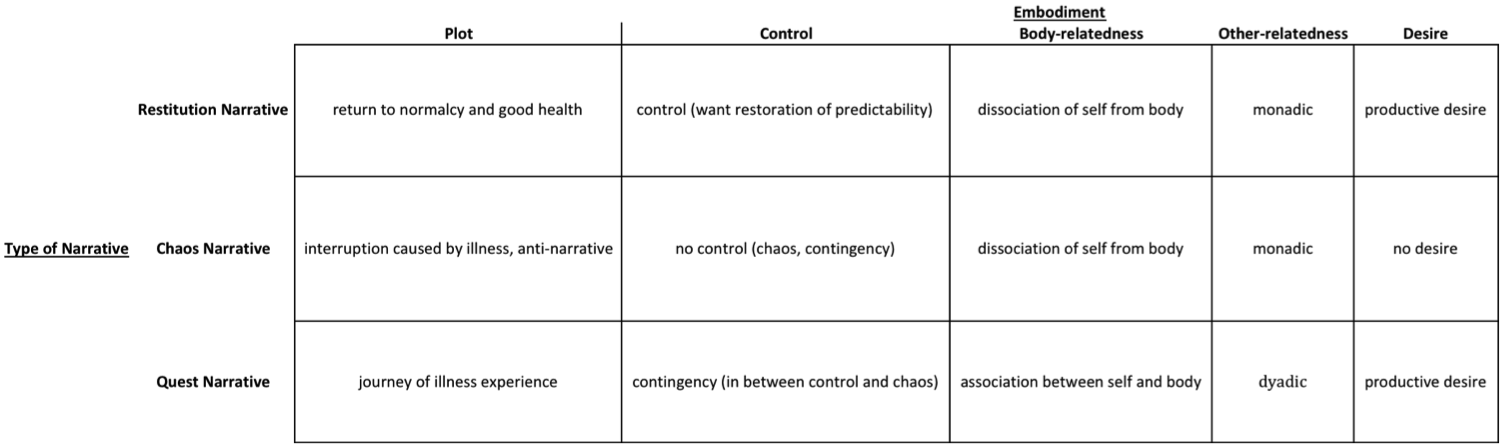
After laying out a basic foundation of illness narratives, Frank delves into his three types of illness narratives: the restitution narrative, the chaos narrative, and the quest narrative. He argues that illness narratives often contain elements and moments of each of these perspectives, and he explores the defining characteristics of each [see table].

The restitution narrative focuses on the conclusion of illness, the ultimate victory over illness, an individual’s reintegration into society and return to the normalcy of everyday life. The chaos narrative claims that “chaos is told in the silences that speech cannot penetrate or illuminate”; thus, the chaos narrative is an anti-narrative that highlights the interruptions caused by illness (101). The quest narrative focuses on the temporal enactment of the illness experience and an individual’s transformation over time.

Frank explains how these narratives coexist and intermingle to compose the illness experience. He toys with the idea of patients as witnesses to illness and illness narratives as a kind of testimony. The concluding chapter explores suffering, for “all illness stories share a common root in suffering as ‘an existential universal of human conditions’” (170). He relates suffering to illness narratives by showing how both telling and hearing stories has the power to heal.

This table outlines the 3 types of illness narratives. Click to enlarge!

Types of Narratives

Discussion Questions:

1. What literary characteristics of an illness narrative can hint at a shift in the type of narrative? For example, what syntax, diction, etc.?

2. How does classifying the narrative type affect the analysis of an illness narrative?

Leave a comment

Filed under Independent Study

Accepting the Limits of Language

While Arthur Frank’s The Wounded Storyteller explored the potency of illness narratives, Kathlyn Conway’s Illness and the Limits of Expression exposes the shortcomings inherent in many of these works. Conway outlines the paradoxical nature of illness narratives: “Literature offers the possibility of representing the shattering experience of illness, but it proves woefully inadequate for depicting the nature of physical pain and the dissolution of the self” (16).

Language as a form of expression, as a means of communicating physical or mental stress, falls short of its demands. Conway denounces the most popular form of illness narratives: the triumph narrative. This form of expression finds fault in its glorification of the illness experience. Often, these are written at the conclusion of an illness experience and reflect on past experiences rather than chronicling illness through its progression. This narrative form aligns with the cultural American belief that “anything is possible,” which makes it of great appeal to the general public (6). These stories are of overcoming illness and disability, of rising above the challenges that they present, and ultimately emerging from this learning experience with enduring strength.

Despite the temptation of reconstructing past illness as triumph narratives, Conway advocates for the importance of non-triumph narratives. She claims that a triumph narrative “enables individuals and the culture to ignore the needs of the ill and disabled,” when instead, illness narratives should illuminate the vulnerabilities of these conditions and the resulting implications (24). Illness narratives present an opportunity to strip illness down to its roots, to boldly expose it for what it is. These narratives track the evolution of the illness in conjunction with the evolution of the self.

Conway exposes the paradoxical nature of illness natures. Literature empowers those who experience illness, but it simultaneously belittles that very experience. While language allows individuals to dissociate the self from the body and to express physical pain through mental thought, narratives also enable the reclamation of the body through an intimate and honest engagement with illness.

Discussion Questions:

1. In what ways are illness narratives paradoxical? What does this paradox reflect about illness? (55)

2. Why does Conway choose to address illness and disability together? How does this affect her argument and her definition of these terms? (14)

3. What is the right way to react or interpret illness narratives? Or rather, is there a right way? (19)

Leave a comment

Filed under Independent Study

Revelations of an Impaired Listener

Frank presents a number of fascinating ideas that have exceeded my expectations by showing how interesting illness narratives are. He outlines how the evolution of illness from premodern to modern to postmodern times. Illness was initially alienated from the disease, which Kleinman defines as the pathological component, because medical terminology existed in isolation as a sort of foreign language. Modern times involved an acknowledgement of illness as a component that was equally as important as disease, while postmodern times have taken this a step further to empower illness with a voice that now echoes through illness narratives.

A fundamental idea that Frank presents is as follows: “The mystery of illness stories is their expression of the body: in the silences between words, the tissues speak.” This situates illness narratives in an in-between state; they transform physical experiences of the body into emotional experiences of the mind, and then translate them into language. Because I’m fascinated about ideas regarding the mind and the body, I wonder how illness narratives fit into this divide and how these aspects of an individual influence this form of communication. According to Frank, illness narratives include four problems with the body: “control, body-relatedness, other-relatedness, and desire” (29). He also categorizes depictions of the body into four different types: “the disciplined body, the mirroring body, the dominating body, and the communicative body” (29).

Perhaps what I found to be most compelling was the idea that there really is no such thing as a singular illness narrative for an individual. Each individual shares multiple illness narratives, largely shaped by the audience and the purpose of its telling. This traps individuals within a multilingual “narrative wreck,” so to speak, a heterglossic discourse. As a result, there are multiple ontologies to illness, and each narrative shapes illness into a different entity. Despite the multiplicity of illness narratives and illnesses themselves, I find it slightly paradoxical that these all originate within a single body.

Realizing that narratives are told in variations has changed the way that I listen. It’s fascinating to see how conversations unfold based on those involved. As I was volunteering at Mott’s Children’s Hospital, I couldn’t help but hear dialogues differently. Conversations with different individuals illuminated different aspects of an illness, depending on the listener: a doctor, a nurse, a child life specialist, a family member, a friend. Just as illness narratives can empower individuals with a voice, exploring them can also provide listeners with the power to hear.

Discussion Questions:

1. Metaphor is common in illness stories. When is it appropriate to find symbolism in illness, and where does the boundary lie? (57)

2. How do illness narratives exist temporally? What transformations do they initiate, especially with regards to individual identity and the multiple ontologies of an illness in the past, present, and future? (60)

3. How does narrative truth function in narrative illnesses, and what is its importance? Frank claims that “in illness stories, truth may be selective, but it remains self-conscious” (62). What does he mean by this, and how can this be seen in present illness narratives?

Leave a comment

Filed under Independent Study