Tag Archives: Medicine

[ACP IMpact] Medical Student Perspective: 10 Tips for Making the Most of Medical School

Since starting medical school a year ago, this website has become relatively silent. I’ve struggled with finding enough time to write for myself and for this blog. I’ve intentionally avoided reflecting on what it’s like to be a medical student here, because there’s just so much to say and so much that I’m still trying to figure out for myself. The American College of Physicians’ Internal Medicine Newsletter for Medical Students (ACP’s IMpact) asked current medical students “What’s Your Top Ten?,” which prompted me to take a step back and distill all that I’ve learned into a list with words of advice for incoming medical students. Although I’ll admit I wrote this list largely for myself, I hoped that it may also be of use to others going through this journey into medicine.

Here it is! I’d love to hear your thoughts.

After my last examination as a first-year medical student, I couldn’t resist this opportunity to write about all that I’ve learned beyond the science and clinical practice of medicine. Medical school is a learning experience unlike any other—and I know that I’m just beginning to scrape the surface—but the first year really is an adjustment for everyone. I’ve thought a lot throughout the past 10 months about how much I have changed as a person, for better and for worse. Although this list is specifically for first-year medical students, I believe many of these tips will sustain me throughout the rest of medical school. My hope is that they may do the same for you.

1. Learn from those around you. 
In medical school, you find yourself surrounded by people you can learn from: your classmates, who have all done extraordinary things and pursued unique passions to be here by your side; your professors, who have a wealth of information that they want to share with you and not enough time to do so; and your mentors, who are eager to impart their wisdom and support you personally and professionally in your journey into medicine.

2. Practice what you preach. 
This isn’t easy, not in medical school nor in a lifelong practice of medicine. Physicians have alarmingly high rates of depression and one of the highest rates of suicide (1). Only 50% exercise weekly, and many physicians struggle with being overweight (2). If we expect it of our patients, it is only fair that we make an effort to embrace the healthy lifestyles that we encourage.

3. Minimize multitasking. 
This may seem counterintuitive to the fast-paced world in which we live, but I believe it’s more efficient to focus entirely on one thing at a time. Try turning off your phone while studying or closing your laptop in class. Make an effort to be mindful and to stay focused on the task at hand despite all the other thoughts that may be running through your mind. Experiment with studying in silence.

4. Be fully present. 
Our patients will come to us to share personal and intimate details about their bodies and their lives—the very least that we can do for them is to be fully present in each moment of our time with them. The art of immersing oneself in a moment comes from being attentive and listening with both your mind and your body; it’s something we should strive to practice as a physician, a student, and a human being.

5. Understand that time is of the essence. 
I’ve found that in medical school, I’ve become acutely aware of time like never before. You learn what it really means to make the most of every minute of the day: flipping through flashcards in the few minutes before class, squeezing in a workout just before the gym closes, or talking on the telephone with friends on your walk home. When you are flooded by information in medical school you may feel pressure to rush through all aspects of your life. Instead of caving to this pressure to rush through everything; try to identify ways to work more efficiently and use your newly found time to slow down and recharge your batteries.

6. Feel.
Whether it be journaling, meditating, or talking to a close friend about the whirlwind of emotions that you feel throughout medical school, take time to reflect on your experiences. One study found that 53% of medical students had burnout (3); just as a career in medicine can be emotionally draining, so, too, can its training. Reflection in some form will help you put these experiences in perspective and come to terms with the sometimes-exhausting nature of medicine.

7. Hold on to what you know.  
Everyone comes to medical school with some idea of who they are and the kind of person they want to be in their career, whether or not you know what kind of physician that may be. Take the time to hold on to what you know, pursue what you are already passionate about, and do the things that you enjoy. Maintain and even strengthen the support system that you already have of family, friends, and loved ones.

8. Explore what you don’t. 
Nevertheless, medical school will no doubt change you. Make the most of this inevitable transformation—embrace it. While holding on to what you know, make space for trying new activities, for learning about what you may never have heard about. Be open to new relationships with the people around you, who are all facing somewhat similar experiences. Let yourself be malleable.

9. Have faith in the system. 
There’s no doubt that medical school is stressful. There is an infinite amount of knowledge to acquire, and medicine is an ever-growing field that never ceases to challenge our thinking minds. Sometimes, it can be overwhelming. It can be a daunting task to think about the sheer amount of knowledge that there is to remember. But, in the end, rest assured that this is all part of the journey.

10. Remember, practicing medicine is a privilege. 
Amidst all that happens in medical school, it can sometimes be easy to forget just what a privilege it is to be a physician. The opportunity to gain this wealth of knowledge about the human body and to study medicine, to devote a lifetime to its practice, is an honor. Being there for people at their most vulnerable is a humbling experience; medicine is gratifying to those who strive to make it so.

The first year of medical school is a time to grow not only in your knowledge but also in your own identity. I know that I’ve taken only the first steps into the field and that there is so much more for me to learn, but, for now, these realizations are enough. I look forward to carrying them forward with me throughout the rest of my journey.

References 
1. Hays LR, Cheever T, Patel P. Medical student suicide, 1989-1994. Am J Psychiatry. 1996;153:553-5. [PMID: 8599405]
2. Medscape Physician Lifestyle Report 2012. Medscape. 2012. Accessed at http://www.medscape.com/features/slideshow/lifestyle/2012/public on July 17, 2015
3. Dyrbye LN, Massie FS Jr, Eacker A, Harper W, Power D, Durning SJ, et al.Relationship between burnout and professional conduct and attitudes among US medical students. JAMA. 2010;304:1173-80. [PMID: 20841530] doi:10.1001/jama.2010.1318

Leave a comment

Filed under Miscellaneous Musings

Bowties, Butterflies, and Band-Aids: a journey through childhood cancers and back to life

Bowties, Butterflies, and Band-Aids. That’s what childhood cancer looks like, according to Lyndsey VanDyke.

bow-ties-butterflies-band-aids-journey-through-childhood-paperback-cover-artThis memoir shares VanDyke’s “journey through childhood cancers and back to life.” From her first diagnosis with Wilm’s tumor at 11 to her relapse at 13 to her secondary thyroid cancer at 21, VanDyke’s coming-of-age has been especially scarred by cancer. With the voices of her family, friends, and care team alongside her own, VanDyke contextualizes her experiences within the views of others. She provides a more holistic perspective through this multiple lenses.

She organizes her reflections as The Cancer, Aftermath, and Reconstruction. In doing so, she illuminates her post-cancer experience, such as the paranoia from her numerous encounters, her experiences living in  fear. Even after pursuing a career in journalism, VanDyke realizes that her heart lies in medicine. She sets out on the path to medical school, eventually finding her place in Osteopathic Medicine.

“It occurred to me that medical school really wasn’t all that different from a cancer experience. It would be exhausting. It would strain my relationships. It would be insanely expensive” (307). And now, she’s Dr. VanDyke.

1 Comment

Filed under Chronicling Childhood Cancer: Illuminating the Illness Experience through Narrative, Literary Narratives

a haiku

I’m not much of a poet, but I wrote a haiku!

Check it out in Pulse–voices from the heart of medicine.
Screen Shot 2015-09-11 at 5.29.41 PM

2 Comments

Filed under Literary Narratives, Miscellaneous Musings

The Art of IF: Navigating the Journey of Infertility through Art

IF.

Short for infertility, a disease resulting in the abnormal functioning of the male or female reproductive system. There are many causes, some known and many unknown. It is often merely a matter of chance, a condition that arises with little explanation.

I have to confess that I had not thought all that much about infertility as an illness until I encountered ART of Infertility, a “an infertility artwork, oral history and portraiture project.” This art exhibit is a compilation of infertility stories expressed through various artistic media, by a diverse range of women who have experienced or are experiencing infertility.

I’ve been struggling to write about this exhibit for months now, but nothing I say seems to do it justice. I guess I just want to say that this exhibit moved me in inexplicable ways. The stories that these women share, the art that they use to express their own inexplicable emotions were incredibly powerful. Their words, their symbols, the hues and textures and things were all used to convey the spectrum of ways that infertility touched each of their lives and their selves.

The ART of Infertility prompted me to realize just how many potential triggers exist in our society for those who are infertile. As a society, we make so many assumptions about how those who are married will have children (or, side note, even those who are not married, for family planning comes up in many professional development discussions with women in medicine it seems). It reminded me of how intimately femininity is often intertwined with the ability to bear children. While this is not always the case, it’s one thing to make the decision not to have children; it’s another thing all together to not have the ability to make that choice.

For those with infertility, the constant reminders of one’s infertility may seem ever-present. Menstruation may be a monthly reminder, a taunt about the body’s reproductive shortcomings. Those struggling with infertility may be surrounded by constant reminders as their peers procreate without problem. There are so many challenges to one’s self that can be inflicted by infertility, challenges that are best told by those who experience it themselves.

I guess infertility is another illness that urges me to wonder how we as a society, as strangers, friends, and family to those invisibly suffering, can cultivate a more sensitive environment. Can we open our minds to the variety of ways that people choose to live their lives and the many aspects that may lie outside of their control? Is it possible for us to cultivate a culture of sensitivity that reconciles the course of majorities with the various paths taken by everyone else? How do we escape the limitations of assumptions and make space for human diversity?

Leave a comment

Filed under Visualizing Illness

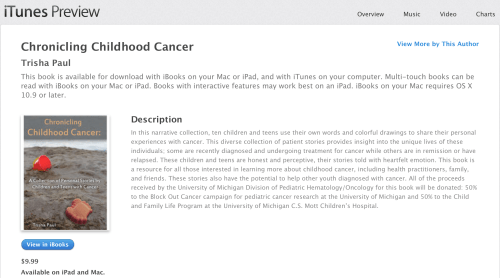
An iBook! Chronicling Childhood Cancer now available for download

If you walk through the infusion clinic at Mott Children’s Hospital, you’ll notice a lot of patients have one thing in their hands: iPads! That’s why I’m excited to announce that Chronicling Childhood Cancer has now been released as an iBook, available for download on any iPad or Mac laptop.

With how widespread iPads are becoming for patients these days, I hope that these new version of the book will be more accessible and able to reach a broader audience. At the very least, I want this book to be available to patients and their families waiting in hospitals who may be interested in perusing it. And as always, all proceeds are donated: 50% benefitting the Block Out Cancer campaign for pediatric cancer research at the University of Michigan, and 50% benefitting the Child and Family Life Program at C.S. Mott Children’s Hospital.

It continues to amaze me how much this project just keeps on growing. A special thanks to Learning Design and Publishing at the University of Michigan Medical School for making this all happen, from the hard copy to the electronic version. I can’t wait to see what’s next!


Chronicling Childhood Cancer on iTunes

Leave a comment

Filed under Chronicling Childhood Cancer: Illuminating the Illness Experience through Narrative, Narrative Medicine Research

1 Week till The Examined Life: Writing, Humanities, and the Art of Medicine

“There is art to medicine as well as science.” -Hippocratic Oath

I find myself thinking about this quote a lot throughout medical school. It reminds me of what initially fascinated me about medicine. While following the pre-medical track lends itself to a scientific foundation for medicine, my non-traditional experiences illuminated the art of medicine to me.

Last year, I found my place at The Examined Life: Writing, Humanities, and the Art of Medicine conference. I was excited to be surrounded by so many other people interested and actively working at the intersections of literature and medicine. These are people who are passionate about all things related to healing and medicine, reading and writing, learning and educating. And I am thrilled to have the opportunity to attend this conference once again, one week from today.

Last year, around this time, I was teaching a mini-course called Grand Rounds: Exploring the Literary Symptoms of Illness through Narrative. This year, I will be leading a discussion forum about this course and about what implications it may have for the use of illness narratives in pre-health education. As I’ve been preparing for our session and sifting through course materials and relevant scholarship, I’m reminded of how much I miss teaching. It won’t be quite the same as leading one of my discussion classes, but I’m really looking forward to the conversations to come.

As a flashback to last year’s presentation: I will also have hard copies of Chronicling Childhood Cancer: A Collection of Personal Stories by Children and Teens with Cancer available for sale this year!
Screen Shot 2015-04-04 at 1.12.22 AM

Leave a comment

Filed under Chronicling Childhood Cancer: Illuminating the Illness Experience through Narrative, Grand Rounds, Narrative Medicine Research

[Inside Stories] Trisha

Although I’ve personally been drawn to the stories of people with illness and disability, I also realize that stories in medicine arise from both sides of health care. Albeit it was admittedly strange (given that I am used to being a listener to these stories), I was excited to have the opportunity to tell my own story about my experiences as a medical student and someday health professional.

Inside Stories is an oral narratives project which invites medical students to share their experiences in medical school in the form of brief podcasts published and archived on in-Training, an online medical student community.  The curator of these stories, Annie Robinson, makes space for medical students across the country to share experiences that they may not otherwise have the opportunity to share. Moreover, it seems to me as though these stories can serve a similar function as do many online illness narratives by bridging together medical students. These exemplify how stories can be used to create a community, to connect different people who may be going through similar situations in their medical training.

Take a listen! My story about medicine and about my childhood cancer narrative research.

Leave a comment

Filed under Chronicling Childhood Cancer: Illuminating the Illness Experience through Narrative, Voice

Kicking Off Childhood Cancer Awareness Month by Answering the Question: Why?

The long-anticipated month of September has finally arrived: it’s National Childhood Cancer Awareness Month.

President Obama issued a proclamation in honor of this occasion, recognizing that this is the time to “remember all those whose lives were cut short by pediatric cancer, to recognize the loved ones who know too well the pain it causes, and to support every child and every family battling cancer each day.”

Moreover, the proclamation acknowledges the multidimensional approach needed for childhood cancer awareness: “We join with their loved ones and the researchers, health care providers, and advocates who support them as we work toward a tomorrow where all children are able to pursue their full measure of happiness without the burden of cancer.”

As I have become more involved in the cause of childhood cancer, people have asked me why. And I think it’s important for me to be upfront about my background. No, I am not a childhood cancer survivor, nor do I have any close friends or family that have gone through the experience. But I believe that you don’t have to be personally touched by childhood cancer to care.

Volunteering with pediatric oncology patients at C.S. Mott Children’s Hospital was all it took to expose me to this different world. For me, getting to know these children and their families and witnessing how cancer permeated their lives made me determined to do something.

While I currently aspire to be a pediatric oncologist and to dedicate my career to these children, I also realize that a lot can change throughout the course of my medical education. Nevertheless, I know that childhood cancer will always be a cause that I hold dear to my heart– I know that I will continue to support these children and their families in whatever capacity that I can.

That’s why I am a firm believer in the Childhood Cancer Awareness Month campaign motto at C.S. Mott Children’s Hospital:

boc web page banner image

Leave a comment

Filed under Chronicling Childhood Cancer: Illuminating the Illness Experience through Narrative, Miscellaneous Musings

Introspection at the Heart of Medicine

This blog post reflects on my artwork in conversation with others, and it is included in the Crossroads blog at The Intima: A Journal of Narrative Medicine

My collage, I will wear my heart upon my sleeve

My collage, I will wear my heart upon my sleeve

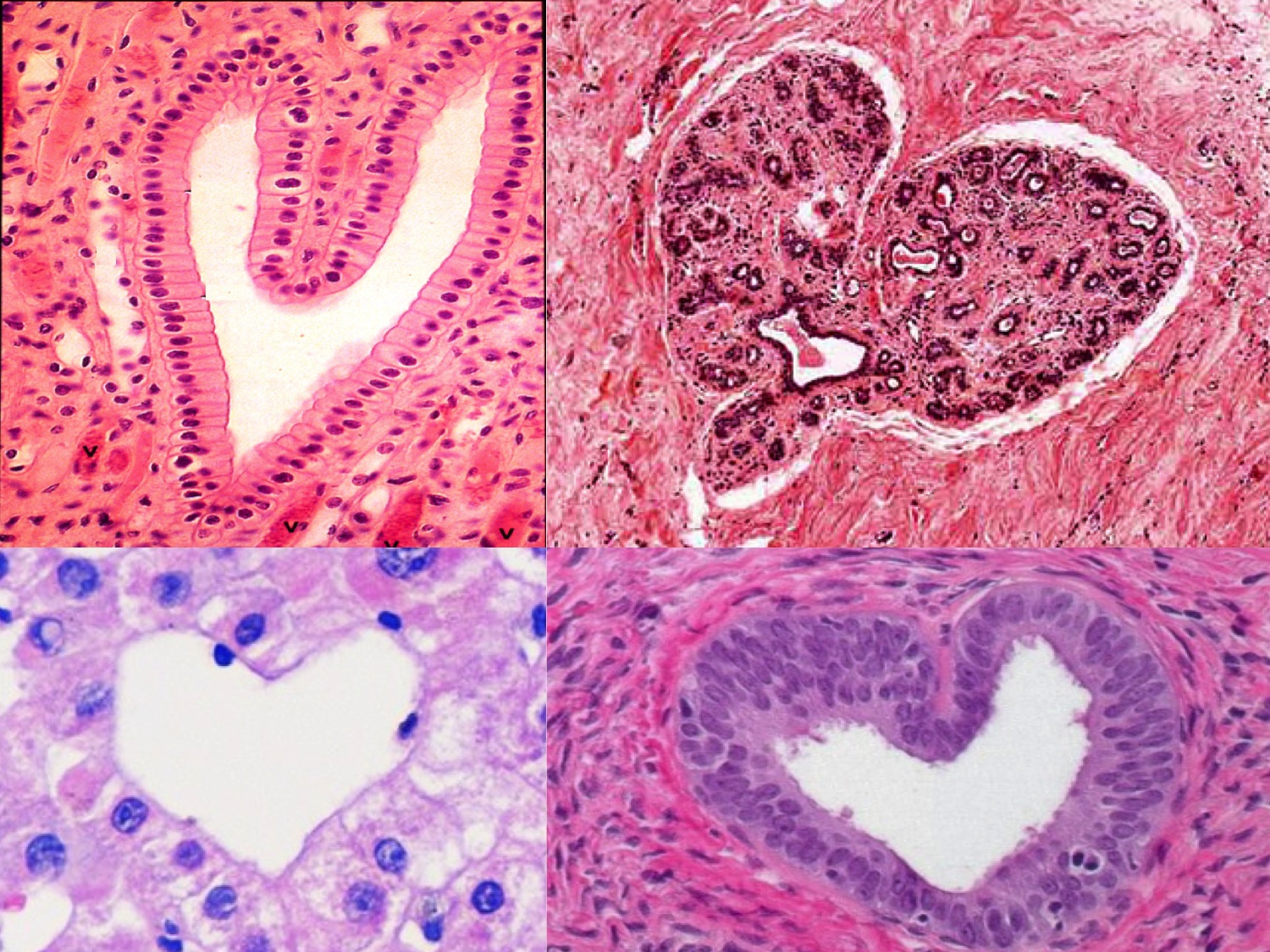
As I examined histological slides, I was struck by the simple beauty of the human body on a microscopic level. These images—still silhouettes of chondrocytes in the hyaline cartilage of joints, scattered pyramidal cells in the cerebral cortex of the brain, pebble-like adipocytes of fat—were each works of art. And, I realized, they all exist within me.

7508213_orig

Khalil Harbie’s The Art of Anatomy

In The Art of Anatomy (shown here), Khalil Harbie also turns his gaze inward to realize the art of the human body on a macroscopic level. He seems fascinated in the musculature of the forearm— the bulk of the brachioradialis, the careful curvature of the flexor carpi radialis, even a hint of the flexor digitorum superficialis. His intricate shading brings to life the texture and dimensionality of the forearm within a planar space, illustrating the very structures that enable this sketch.

Introspection enables a new way of seeing oneself that permeates into how one views and interacts with the external world. Only with introspection, I posit, can we begin to connect with those around us and truly achieve empathy. The core skills of doctoring, of listening and adequately responding to the suffering of other human beings, depend on an understanding of the self.

The human body, and human life as whole, is aesthetic by nature. We are colorful, we are shapely, we are beautiful. Art is at the heart of scientific studies like histology and anatomy because, in essence, art is the heart of humanity.

Leave a comment

Filed under Narrative Medicine Research, Visualizing Illness

Excited for The Examined Life conference: Writing, Humanities, and the Art of Medicine

When I attended the WMU Medical Humanities Conference last fall, I heard about an upcoming conference called The Examined Life: Writing, Humanities, and the Art of Medicine. And now, I’m fortunate enough to not only be attending this conference but also be presenting about my childhood cancer narrative research!

The Examined Life conference explores “the links between the science of medicine and the art of writing.” This conference seems to align perfectly with my own dual interests in medicine and literature. I think that participating in this conference will help me to figure out how I can maintain and balance both passions throughout my career, and I’m looking forward to meeting others in these fields with their own insight and experience to share.

At the Examined Life conference just one week from now, I’ll be doing something a bit different. In writing my Honors English thesis over the course of this year, I realized just how crucial my methodology has been in shaping the adolescent cancer narratives that I wanted to analyze. As a result, rather than just presenting about my research, I’ll be leading a discussion forum this time. Specifically, we will be discussing the ethics inherent in my methodology and thoughts that may be sparked from encountering these narratives. I’m curious, nervous, and excited to see what comes out of this discussion. I believe that these conversations will give me a lot to think about as I look towards further developing my honors thesis.

Here’s the abstract for my discussion forum:

Chronicling Childhood Cancer: Illuminating the Illness Experience through Narrative

I’ve never been to Iowa! I’m excited.

2 Comments

Filed under Chronicling Childhood Cancer: Illuminating the Illness Experience through Narrative, Miscellaneous Musings, Narrative Medicine Research