Tag Archives: University of Michigan

I will wear my heart upon my sleeve

I will wear my heart upon my sleeve

The heart has long been appreciated as a vital organ in the body, one whose persistent beating sustains human life. During the Middle Ages, the heart fell under the scrutiny of a variety of philosophers. Some, like Aristotle, reasoned that the heart, not the brain, was the important organ of the body that dictates human reasoning and rationality. Others believed the heart held different responsibilities as the seat of the soul, a place of emotion and passion.

The heart as a representation of love has survived especially through the heart shape, a symbol that has been prominent since the end of the Middle Ages. The simple heart shape has become a metaphor for affection, for lust, for devotion. As the image primarily associated with Valentine’s Day, it remains powerfully resonant of love.

In Othello, Shakespeare alludes to the importance of expressing such emotion with the phrase “I will wear my heart upon my sleeve.” The phrase once referred to the jousting tradition where knights wore colors that matched their respective ladies. Now, this idiom alludes to displaying emotions openly and fearlessly.

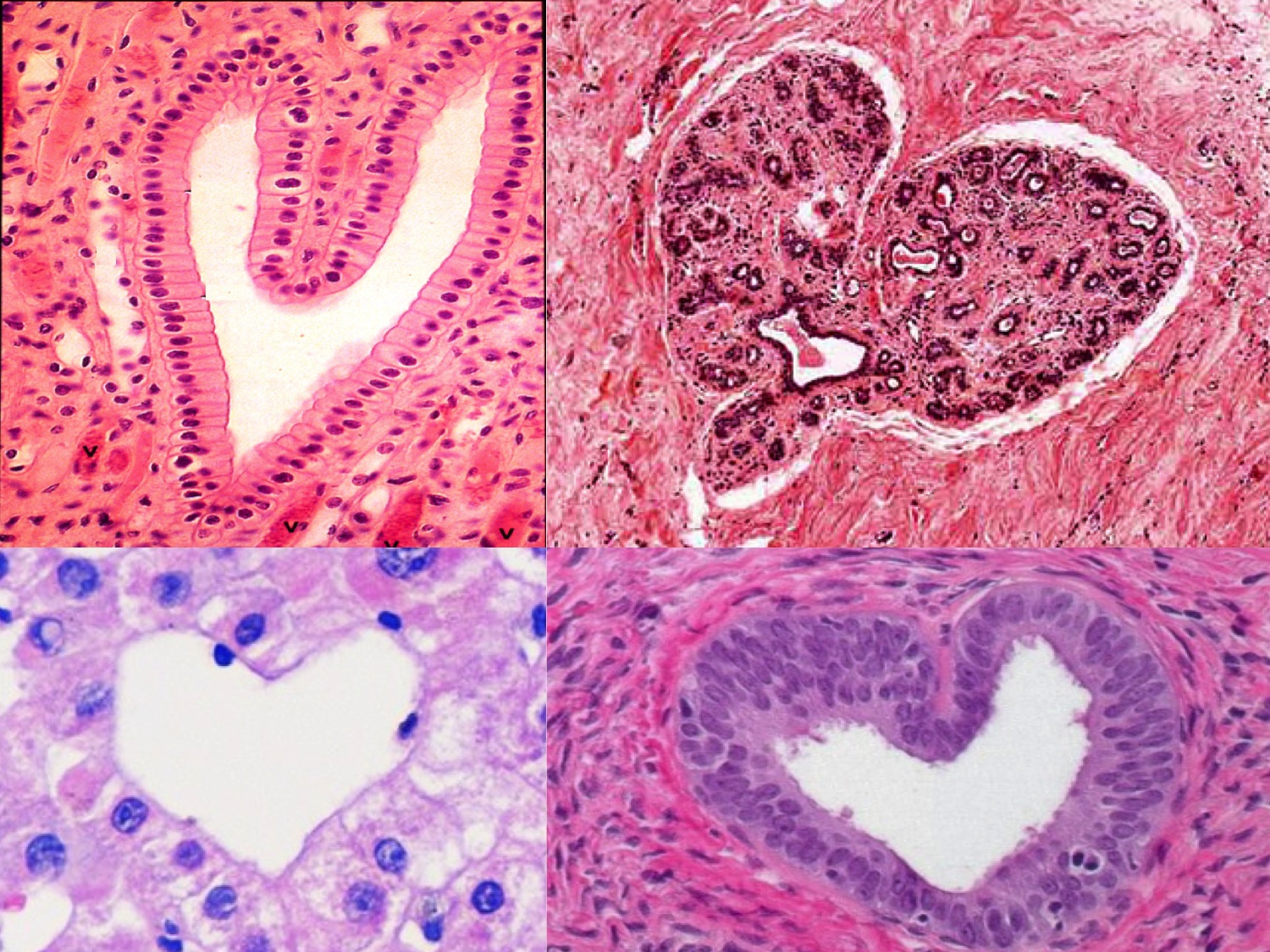
This collage, motivated by the recurring appearance of the heart shape in non-cardiac tissue, demonstrates how the heart shape we so commonly associate with love can in fact exist outside the organ of the heart. Taken from kidney, mammary gland, liver, and prostate gland tissue, these samples demonstrate how the heart shape lives on structurally in other bodily organs. These hearts are constructed with different kinds of epithelial tissue from simple cuboidal epithelium to simple squamous epithelium; different cells come to naturally construct the heart shape. The array of colors arose from the different dyes used to illustrate the tissue structures. The basic dye hematoxylin binds to basophilic components like nucleic acids and ribosomes, while the acidic dye eosin binds to acidic components like protein. Although the heart shape is embodied differently in these various organs, it maintains the basic structure of two symmetrical halves that coalescence to create a whole.

Passion and love are not isolated within the cardiac tissue of the heart. Instead, these emotions circulate throughout the entire body. We must embrace these naturally permeating feelings, and so, “I will wear my heart upon my sleeve.”

I was honored to be selected as the Grand Prize Winner of the Science as Art Contest for this artwork and description.

This content is licensed under a Creative Commons: Attribution-NonCommercial-ShareAlike license (CC:BY-NC-SA).

1 Comment

Filed under Miscellaneous Musings, Visualizing Illness

Sharing the Clinical Relevance of Narrative at the UM Pediatrics Research Symposium

Instead of numerical values and statistics, my poster shared the words and phrases of children with cancer.  Amidst colorful posters with tables and graphs, my poster was adorned with drawings by pediatric oncology patients, such as cancer as a half-angel, half-devil being.

The 24th Annual Pediatric Research Symposium at the University of Michigan struck me as an interesting opportunity to share my narrative research with clinical pediatricians. I just began delving deeper into these narratives through a literary lens, and I enjoyed the challenge of reframing and furthering my analysis of these narratives for a medical audience. What does narrative illuminate about the living experience of childhood cancer? How do children conceptualize cancer and make sense of their illness experiences? And how can these narratives of pediatric oncology patients inform those who care for them?

Writing this abstract required more than inverting the active tense valued by the humanities to the passive tense valued in scientific writing. Designing this poster forced me to distill the numerous conversations and narratives that I have collected into a direct, concise argument. It was an incredibly helpful, albeit challenging, process.

From nearby poster presenters to practicing pediatric oncologists and more, it was interesting to discuss my research with a broad range of people and receive different feedback. One conversation in particular really resonated with me. A neighboring poster presenter asked me about my work, then confessed that she worked with pediatric oncology patients as a social worker for years. She said that it was a difficult and challenging position, one that ultimately surged her into depression because it was too much. To be able to work so intimately with these children, she said, “you need some kind of ‘distance.'”

This “distance” intrigues me. As we discussed this further, she explained that social workers preoccupy themselves primarily with the patients and families facing death, the ones struggling most with the interruptions of cancer. Physicians, on the other hand, have the chance to experience the broad range of paths that patients follow with cancer. The successful treatments, the ineffective drug regimens. This spectrum of outcomes helps give physicians perspective, but social workers by nature are honed in on the more despondent stories.

Is “distance” necessary for the emotional challenges of pediatric oncology? And if it is, what exactly does this imply about the impact of these childhood cancer narratives?  I wonder, how might these narratives complicate and possibly challenge this notion of ‘distance’?

Leave a comment

Filed under Chronicling Childhood Cancer: Illuminating the Illness Experience through Narrative, Miscellaneous Musings, Narrative Medicine Research

Block Out Cancer: Helping Children Tell Their Stories

C.S. Mott Children’s Hospital has a campaign for childhood cancer awareness month: Block Out Cancer. Block Out Cancer is “a rallying cry for people from all walks of life to come together to support the fight against children’s cancers.”

I’m honored that Mott has featured this blog post I wrote about my project:

My name is Trisha, and I help children tell their stories to Block Out Cancer.

mott-blog-BOC-thumb


Leave a comment

Filed under Chronicling Childhood Cancer: Illuminating the Illness Experience through Narrative, Literary Narratives

My Other Voice: Giving Voice to Young Adult Cancer

On the brink of graduation and a Broadway career, cancer threatened to take Alex Kip’s voice and his life. Two years later, Kip has held on to both, and he is sharing his story through theatre.

My Other Voice is a play written by Kip about his personal experiences as a young adult with cancer, starring Kip himself. Upon diagnosis, his mind was set on recovering in time for the “silly” senior showcase that doctors didn’t understand. When Dr. Foster asks Kip’s mom to break it to him that he would not be able to participate, this responsibility lingers; when it finally reaches Kip, he becomes distraught and untrusting. Interactions with the medical realm conveyed an arousing critique, calling for greater sensitivity in medicine. For respecting what patients value most in their lives and appreciating these needs whenever possible.

Kip experiences the destruction and recreation of identity as he loses his singing voice and finds a new one. As a patient, he loses independence and his sense of control as he is forbidden to work out. Cancer’s disruptive nature into Kip’s life as well as those around him is brought to life by the realness of each character. Each person responds to Kip’s cancer differently, physically and emotionally. Their actions and coping mechanisms vary, and getting to know these nuanced personalities and witness their transformations was a resounding effect of the play. The personal nature of illness as it permeates into lives is performed.

With the intimacy of the thrust stage, the audience is immersed in the performance. With young adult dialect, iMessages, and popular rap music, we enter into the college life. We even follow Kip and his friends as they get high off magic brownies infused with marijuana. Amidst the devastation of cancer, Kip finds friendship in a fellow cancer patient. Amy redefines what it means to have cancer, explaining that “You’re a survivor the day you start fighting.” While she herself does not survive in the traditional sense, her voice remains influential to Kip. Amy’s death illuminates the emotional depth to cancer, the disease reasserting itself as a threat to vitality.

Following the performance was a talk-back session led by Dr. Ora Pescovitz, the CEO of the U of M Health System. Through an interactive conversation with performers and audience members, some of the ideas introduced by the play were given voice. The discussion revolved around the controversy of medical marijuana, critiques about the medical profession, and value for artistic therapies in patient care.  I asked Kip a question of my own:

How did the experience of retroactively narrating through play differ from writing a Caring Bridge blog throughout treatment?

Kip noted how the therapeutic process of writing began to substitute for his lost voice. He explained that in adapting his story to play form, he referred to his Caring Bridge posts and some of his private journal entries. These helped him to reconsider the disturbing, to remember the forgotten. “When I was sitting in the hospital I realized that I could use my gifts to make a different in the fight against “cancer” (UM Cancer Center interview with Kip).

Kip demonstrates how everyone can play a role in the illnesses experience. The play may conclude with Kip singing alongside his loved ones, but his revitalized voice continues to resound.

Leave a comment

Filed under Chronicling Childhood Cancer: Illuminating the Illness Experience through Narrative, Theatre, Voice

Bioartography: Art Inherent in Science

Microscopic slides = masterpieces.

Bioartography is a joint venture by scientists and artists across the University of Michigan campus. This program identifies the artistic nature of scientific studies and illuminates them through a microscopic lens. A panel of artists and scientists contribute their perspectives, and the profits of these sales fund scientific research. Some of these creations have even been adapted and pieced together as quilts by the Healing Quilts in Medicine program. By far, an art fair favorite.

Inspired by Bioartography, I created this collage.

A collection of tissue slides in the shape of a heart, although ironically not from the heart.

I <3 Histology

<kidney, mammary glands, liver,  prostate>

A collection of tissue slides in the shape of a heart, although ironically not of the heart.

2 Comments

Filed under Visualizing Illness

ICD Connection: Illuminating the Patient Experience

For months, I have been eager to read ICD Connection: Living with an Implantable Cardioverter Defibrillator: A Collection of Patient & Family Stories. I’ve heard so much about this book through working at the UM Medical School, and it’s been exciting to watch UM transform these works into a published creation that gives ICD patients a voice.

ICD stands for Implantable Cardioverter Defibrillator. “It is a device smaller than a deck of cards that is implanted under the skin to treat life-threatening heart rhythms that can lead to sudden cardiac arrest” (McFarland: Pelosi i). While the ICD certainly saves lives, policing the heart’s every  heartbeat, it brings with challenges of its own. This is what the patients and families featured in the ICD Connection book aim to illuminate.

The idea behind this book came from the Young ICD Connection event, which brings together people from around the country who are living life with an ICD. This event inspired Helen McFarland, a nurse who has worked with ICD patients for years, to create this compilation of stories. She was eager to explore the psychological and social side effects of the ICD, to enable patients and families to tell their stories to have their voice be heard.

I must say, this collection has been one of my favorite set of illness narratives. The honesty and authenticity of these stories and the genuine intentions behind writing them shine through, empowering this collection to have resounding effects on any reader. Each short story was unique and moving, and the writers brought incredible insight about their own lives and the ways that the ICD had affected them from within. These stories reflected the perspectives of boys and girls, men and women, dads, husbands, and daughters. I loved the eclectic selection of experiences that all seemed to supplement each other but also stand apart. For example, the pairing of Erika’s perspective of having an ICD with Bryan, her husband’s perspective of her ICD, was interesting to explore.

Amongst many powerful ideas, I found one statement that seemed to reflect the foundation behind this book. “Emotional roller coasters are a very normal part of any health challenge, and every patient has a right to feel however he or she feels and work through those emotions in whatever way he or she needs to. No one is the same, and no one deals with anything exactly the same” (McFarland: Lisa 85-86).

1 Comment

Filed under Literary Narratives