Tag Archives: childhood cancer

Excited for The Examined Life conference: Writing, Humanities, and the Art of Medicine

When I attended the WMU Medical Humanities Conference last fall, I heard about an upcoming conference called The Examined Life: Writing, Humanities, and the Art of Medicine. And now, I’m fortunate enough to not only be attending this conference but also be presenting about my childhood cancer narrative research!

The Examined Life conference explores “the links between the science of medicine and the art of writing.” This conference seems to align perfectly with my own dual interests in medicine and literature. I think that participating in this conference will help me to figure out how I can maintain and balance both passions throughout my career, and I’m looking forward to meeting others in these fields with their own insight and experience to share.

At the Examined Life conference just one week from now, I’ll be doing something a bit different. In writing my Honors English thesis over the course of this year, I realized just how crucial my methodology has been in shaping the adolescent cancer narratives that I wanted to analyze. As a result, rather than just presenting about my research, I’ll be leading a discussion forum this time. Specifically, we will be discussing the ethics inherent in my methodology and thoughts that may be sparked from encountering these narratives. I’m curious, nervous, and excited to see what comes out of this discussion. I believe that these conversations will give me a lot to think about as I look towards further developing my honors thesis.

Here’s the abstract for my discussion forum:

Chronicling Childhood Cancer: Illuminating the Illness Experience through Narrative

I’ve never been to Iowa! I’m excited.

2 Comments

Filed under Chronicling Childhood Cancer: Illuminating the Illness Experience through Narrative, Miscellaneous Musings, Narrative Medicine Research

3/24/14: The day I turned in my Honors English Thesis

To be honest, this is probably the most important thing that I’ve done in my life.

My Honors English thesis

I know it sounds dramatic, but I can’t help but think that it’s true. I’ve been excited about writing a thesis since coming to college. I had no idea what it would be about, but I loved the idea of turning my own thoughts into something new. My English teacher once told me that I was a seeker; I enjoy turning to literature for answers and embracing its ambiguity. And in many ways, that is what I’ve done in my Honors English thesis.

It’s hard for me to wrap my mind around just how much of myself I’ve devoted to this research. But in many ways, this thesis is the culminating creation of my entire undergraduate education here at Michigan and more. Volunteering with pediatric oncology patients in high school initially piqued my interest; now, I’ve become dedicated to hopefully getting involved in childhood cancer as a physician. I needed to do this research: for these individuals with cancer who have had such an impact on my life but also for me, as a way of making sense of these unfathomable lives.

These final days have also been a time for remembering how fortunate I am to have so many people in my life supporting me. A close friend willingly contributed an extra set of eyes and an additional brain towards the editing process. From front to back, my mom read my entire thesis for typos. My dad morally supported me in the final stretch, and even my brother helped me to perfect the images. It’s been humbling to watch my loved ones step aside from their lives and devote their time to my own project.

Throughout the process, I’ve said that all I wanted was to be able to turn my thesis in knowing that I did everything I could and that I personally am happy with it. By my own standards, I believe that I’ve successfully accomplished this goal, and I couldn’t be more content.

If nothing else, the fact that I found myself eager to write this blog post and excited to dive into John Green’s  The Fault in Our Stars to celebrate  says something to me. I know that in studying literature, I’ve truly been doing something I love.

6 Comments

Filed under Chronicling Childhood Cancer: Illuminating the Illness Experience through Narrative, Miscellaneous Musings, Narrative Medicine Research

‘Brave’ Pediatric Oncology Patients at UMinnessota’s Amplatz Children’s Hospital

“Say what you wanna say
And let the words fall out
Honestly I wanna see you be brave”

The lyrics of Sara Bareilles’ song Brave struck me. They reminded me of the purpose behind my research and my Honors English thesis: to give children and adolescents a chance to tell their own stories. And, to give all those involved the opportunity to listen, to better understand how these children and adolescents cope with the complex, mysterious illness of cancer. In my mind, the bravery arises in how children are talking and writing about their intimate experiences with cancer.

From Stronger to Roar and now Brave, my emotions are mixed about these charged music videos about the sphere of pediatric oncology. While the Stronger and Roar videos ask for donations to support childhood cancer research in the caption, this video of Brave only links to additional information about the programs offered. I wonder, how does the purpose behind these videos affect how we should respond to them?

I have to say, one of the best things about these music videos is that they counter common misconceptions about childhood cancer. Every time I tell someone that I want to be a pediatric oncologist, people stare at me and say, “Oh. That’s so depressing” or “That’s so sad!”. I’m not saying that it’s not going to be an emotionally challenging career, but at the same time, these are truly incredible and lively children. These videos portray the fun and joy  that is also part of pediatric oncology. These children embrace their passions and make the most of their time in hospitals by playing games, making crafts, and finding reasons to laugh.

That’s why these videos make me smile.

Leave a comment

Filed under Chronicling Childhood Cancer: Illuminating the Illness Experience through Narrative, Dance, Film, Theatre

A Childhood Cancer take on Katy Perry’s Roar

Similar to Seattle Children’s Hospital’s performance of Stronger by pediatric oncology patients and staff, the Children’s Hospital at Dartmouth-Hitchcock did their own rendition of Katy Perry’s song Roar. This powerful video unites pediatric oncology patients, their families, and the healthcare professionals that treat them come together to sing how “you’re going to hear me roar.”

Leave a comment

Filed under Chronicling Childhood Cancer: Illuminating the Illness Experience through Narrative, Film, Uncategorized, Voice

Sharing the Clinical Relevance of Narrative at the UM Pediatrics Research Symposium

Instead of numerical values and statistics, my poster shared the words and phrases of children with cancer.  Amidst colorful posters with tables and graphs, my poster was adorned with drawings by pediatric oncology patients, such as cancer as a half-angel, half-devil being.

The 24th Annual Pediatric Research Symposium at the University of Michigan struck me as an interesting opportunity to share my narrative research with clinical pediatricians. I just began delving deeper into these narratives through a literary lens, and I enjoyed the challenge of reframing and furthering my analysis of these narratives for a medical audience. What does narrative illuminate about the living experience of childhood cancer? How do children conceptualize cancer and make sense of their illness experiences? And how can these narratives of pediatric oncology patients inform those who care for them?

Writing this abstract required more than inverting the active tense valued by the humanities to the passive tense valued in scientific writing. Designing this poster forced me to distill the numerous conversations and narratives that I have collected into a direct, concise argument. It was an incredibly helpful, albeit challenging, process.

From nearby poster presenters to practicing pediatric oncologists and more, it was interesting to discuss my research with a broad range of people and receive different feedback. One conversation in particular really resonated with me. A neighboring poster presenter asked me about my work, then confessed that she worked with pediatric oncology patients as a social worker for years. She said that it was a difficult and challenging position, one that ultimately surged her into depression because it was too much. To be able to work so intimately with these children, she said, “you need some kind of ‘distance.'”

This “distance” intrigues me. As we discussed this further, she explained that social workers preoccupy themselves primarily with the patients and families facing death, the ones struggling most with the interruptions of cancer. Physicians, on the other hand, have the chance to experience the broad range of paths that patients follow with cancer. The successful treatments, the ineffective drug regimens. This spectrum of outcomes helps give physicians perspective, but social workers by nature are honed in on the more despondent stories.

Is “distance” necessary for the emotional challenges of pediatric oncology? And if it is, what exactly does this imply about the impact of these childhood cancer narratives?  I wonder, how might these narratives complicate and possibly challenge this notion of ‘distance’?

Leave a comment

Filed under Chronicling Childhood Cancer: Illuminating the Illness Experience through Narrative, Miscellaneous Musings, Narrative Medicine Research

Slate: Stigmas of Cancer

An interesting article about the various stigmas of cancer and their implications:

Cancer stigma: Don’t blame patients for their disease, no matter what the risk factors.

Which leads me to question, what are the stigmas of childhood cancer?

3 Comments

Filed under Chronicling Childhood Cancer: Illuminating the Illness Experience through Narrative, Miscellaneous Musings

“Through the Fire”: Melinda Marchiano’s Childhood Cancer Dance

In addition to sharing her story through the book Grace, Melinda Marchiano gave voice to her experiences through a language of her own: dance. Through the Fire embodies her illness experience with childhood cancer.

A beautiful, moving performance.

Leave a comment

Filed under Chronicling Childhood Cancer: Illuminating the Illness Experience through Narrative, Dance

Block Out Cancer: Helping Children Tell Their Stories

C.S. Mott Children’s Hospital has a campaign for childhood cancer awareness month: Block Out Cancer. Block Out Cancer is “a rallying cry for people from all walks of life to come together to support the fight against children’s cancers.”

I’m honored that Mott has featured this blog post I wrote about my project:

My name is Trisha, and I help children tell their stories to Block Out Cancer.

mott-blog-BOC-thumb


Leave a comment

Filed under Chronicling Childhood Cancer: Illuminating the Illness Experience through Narrative, Literary Narratives

Grace: Tracing Childhood Cancer Through Treatment and Beyond

Melinda Marchiano and I share a number of similarities. We are writers who come to understand the world and our own experiences through language. We are dancers who have unearthed a passion that we will pursue for the rest of our lives. We are aspiring pediatric oncologists, eager and excited to pursue medical careers. But unlike Melinda, I’ve only encountered cancer from “the outside of the needles and sickness” (Greer 52).

graceI met Marchiano by reading her memoir, Grace: A  Child’s Intimate Journey through Cancer and Recovery. Marchiano writes her story in journal entries of sorts with interspersed snapshots of milestone memories and powerful quotes. She reflects deeply on her cancer experiences, sharing her thoughts on the diagnostic label of cancer, the paradoxical effects of chemotherapy, and the tensions of mind and body through illness. Her conversational and confessional writing reveals her sense of humor and personality.

Marchiano’s comprehensive memoir seems to capture the essence and nuances of her experience with childhood cancer. Rather than attempt to summarize these, here are just some of many excerpts that were particularly compelling to me:

“[Chemotherapy’s] a sort of ‘chemical feeling,’ like battery acid that races through your veins. I felt terrible, and as I write this now, recalling how sick I was, nausea and dizziness have returned to me. I only now noticed that, feeling so passionate about my writing, I am virtually reexperiencing it. Chemo may eventually leave your body, but it always stays with you” (50).

“I longed for the feeling of dancing, the feeling of freedom, the feeling of the studio air filling my lungs, and the feeling of my heart beating as one with the music. I decided I would work hard. I would do it…I would dance again. The fear of hard work did not exist within me. Becoming accustomed to pain, I now didn’t care one bit how badly anything hurt” (119).

“I noticed that, hey, maybe I did have a story. But if, indeed, I did, I didn’t really think that anyone would want to hear it” (140).

“When I wrote my speech, I questioned how much I should share. Pondering it for quite some time, I decided to lay it all on the line, to give it to them straight. Cancer does exist. My suffering was real, and I needed to acknowledge that” (224).

“Cancer kids need just as much help after treatment as during. We’re like giant walking wounds, with each touch stinging and painful. Only time can make the wound scab over and begin to heal. But during that vulnerable time, we need a Band-aid” (272).

Marchiano now advocates strongly for childhood cancer research. In sharing her story, she has found that “my cancer had a meaning– a purpose. It was doing what I thought it was not capable of doing — giving” (196).

2 Comments

Filed under Chronicling Childhood Cancer: Illuminating the Illness Experience through Narrative, Literary Narratives

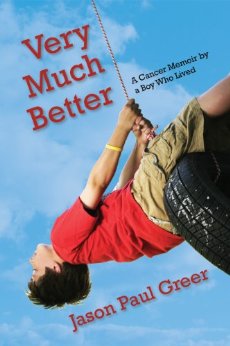
Very Much Better: A Survivor Reflects and Relives Childhood Cancer

“Cancer was everywhere. There was no moment, thought, idea, ache or pain, burst of energy or breathless moment that didn’t change, or wasn’t changed by my cancer– there was always a piece of it with me, somewhere, in something.” (67)

very much betterJason Greer’s memoir Very Much Better holds within it a piece of his cancer. Diagnosed with Ewing’s sarcoma on the brink of adolescence, Greer leaves behind his hometown in Montana for the Children’s Hospital in Seattle, Washington. But he finds strength in support from his loved ones, family and friends . For Greer, “faith…is the crying from inside the soul to plunge into living”; his beliefs energize him throughout his journey (117).

Greer smoothly melds his retroactive retelling of the past with “a look back” from his present point of view. We become familiar with Greer as an 11-year old boy and as a  grown-up adult, the during and the after of cancer, and we witness how the disease matures him hastily. He intersperses medical terms such as “pre-op” or “outpatient,” denoting their foreign nature by quotation marks (10;14). With witty chapter titles like “The Art of Throwing Up” and “The Cancer Patient’s Guide to Duct Tape,” personality and a sense of humor shine through each adventure (xi).

What struck me most about Greer’s memoir was his powerful grasp of his experiences. Particularly eloquent was his ability to capture one of the most emotional aspects of coping with childhood cancer: losing others to the disease. The deaths of Erik, Chad, and Jesse are each heart-wrenching in their own right, and Greer illuminates their important place within his own cancer experiences.

“Cancer threatened each of us, for a time was inescapable, and seemed to be everywhere. But as we sat in the company of each other’s encouragement, we surrounded the disease — and we defied it, every part of it” (83).

Leave a comment

Filed under Chronicling Childhood Cancer: Illuminating the Illness Experience through Narrative, Literary Narratives