A noon conference for pediatrics residents with Chronicling Childhood Cancer authors

Perhaps it was the ambience of a brightly lit conference room overlooking downtown Ann Arbor. Maybe it was the audience of pediatrics residents at C.S. Mott Children’s Hospital, doctors devoting their lives to caring for children. Or it may have been this event’s focus on teens sharing their own advice for doctors based on their personal experiences. Whatever it was, something was very different about the Pediatrics Noon Conference that I led about the Chronicling Childhood Cancer book project from last year’s Literati book reading/signing event.

A couple months ago, I learned that residents hardly have an opportunity to interact with pediatric patients and their families outside of clinic visits. I was surprised–while medical school is peppered with patient presentations and opportunities to learn more from patients about their experiences, it seems as though these opportunities drop off in residency since residents have patients of their own.

That was unsettling to me, though. Especially with pediatric patients, I think that giving teens and young adults the chance to share their own experiences and perspectives can be invaluable, both for these youth as well as for people who are devoting their lives to caring for these individuals. It’s also a reminder of what it means to embrace PFCC, or patient- and family-centered care: the recognition that we as clinicians must view our patients as partners in their healthcare, and in doing so, acknowledge how much we can learn from our patients. Events such as these demonstrate that there are an infinite number of ways that we can improve and better care for our patients by hearing what they have to say.

At this event, I gave a brief overview of the research project before turning it over to three of the young authors themselves. Each individual shared some of their personal experiences and advice for doctors about just how much of an impact their interactions can have on patients. While the discussion was centered largely on the teens, their parents also contributed some insight. Overall, this was a change from the typical noon conference lecture, and it sounds like many appreciated what this unique noon conference had to offer.

I was more anxious preparing for this event than I have been in a while, and I think it’s because I’m more aware of how precious time in medical education can be. I know how much people fight over this time to make an impression on doctors in the making. It truly is incredible to me that I have had this opportunity; it’s crazy to think that I have been a part of their education, that I may have been able to influence the kind of physician that some of these residents may be with their patients.

One of the highlights for me was the very end. A number of people had to leave immediately since the event concluded right at 1pm, but I was amazed by how many people still chose to stick around and speak at length with each of these patients and their families. That meant so much to me, and I know that it meant a lot to the young authors. Instead of just getting their books signed and leaving, these residents took the time to connect with the teens and their parents. In the end, I know that this was the point of it all: to give residents a chance to get to know and learn from teens with cancer in a different way, and to make space for teens to share their personal experiences.

Pediatric Noon Conference- Outline

Pediatrics Noon Conference- Slides

Leave a comment

Filed under Chronicling Childhood Cancer: Illuminating the Illness Experience through Narrative

Childhood Cancer Awareness: September is just the beginning

Every year, I am energized by the month of September. There’s something about Childhood Cancer Awareness Month that brings me back to the Friday evenings that I’ve spent with pediatric oncology patients and their families over the years. I am reminded of the time I devoted to getting to know these children and teens through my research; I have been so moved by these children, teens, and families. This month reawakens in me my desire to raise awareness of childhood cancer, namely by helping to spread the word about the Chronicling Childhood Cancer book.

It takes an incredible amount of courage and strength to do what these young authors, these children and teens, have done– to share their personal experiences with cancer. That’s why I want these stories to be heard by as many people as will listen. I believe that the Chronicling Childhood Cancer book really is unique and compelling, that anyone and everyone can learn something from it. I guess that’s why I’m so motivated to share these stories and shamelessly promote the book.

I’ve blogged extensively (and perhaps annoyingly) about the book, but here’s the rundown:

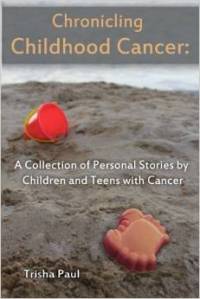
UnknownChronicling Childhood Cancer: A Collection of Personal Stories by Children and Teens with Cancer is a book that was created from a project that I started with C.S. Mott Children’s Hospital patients for my Honors thesis in English. All of the proceeds of this book are donated to Mott: 50% to the Block Out Cancer campaign for pediatric cancer research at the University of Michigan and 50% to the Child and Family Life Program at Mott.

This month, I’ll be sharing daily excerpts from the book via Twitter to raise awareness about childhood cancer. It feels strange to be taking these quotes out of context and into the 135-character tweets, but my hope is that this is a way for me to make them more accessible to a larger audience. To offer a sneak preview of sorts, into the Chronicling Childhood Cancer book as well as into the personal lives of these young children and teens with cancer.

While September gives me momentum, I know that this one month is not enough for this important cause. So much has to happen, and to pretend as though one month were enough time to raise ‘enough’ awareness (if there even were such a thing) is absurd. So stay tuned for more about what I have planned for this year!

Leave a comment

Filed under Chronicling Childhood Cancer: Illuminating the Illness Experience through Narrative

Helping: A podcast interview

About a year ago, I had the opportunity to share my journey into medicine through Inside Stories. Now, after finishing my first year of medical school, it was a pleasure to chat with  J.J. Bouchard, a Certified Child Life Specialist and Certified Therapeutic Recreation Specialist at C.S. Mott Children’s Hospital, about my experiences helping others.

Helping: Conversations with Child Life Specialists and Other Helper Professionals is a podcast that features people who have dedicated their lives to helping others. I was truly honored to participate in this podcast project and to have a chance to reflect on my experiences as a helper and what being a helper means to me. In this podcast, I shared some of my experiences with the Chronicling Childhood Cancer narrative project and the book, as well as the current volunteer work that I’ve become involved in as a medical student.

J.J. was instrumental in helping me with my research project (as you’ll hear about if you listen to the podcast!), and his podcasts provide great insight into the stories of people who devote themselves to helping others. It is incredible to me the variety of ways that people choose to make a difference in the lives of others, and listening to these podcasts has reminded me that there is so much that we can learn from each other.

Check out the podcast here, and subscribe to hear more from other helper professionals!

http://www.helpingpodcast.com/?page_id=10

Leave a comment

Filed under Chronicling Childhood Cancer: Illuminating the Illness Experience through Narrative, Miscellaneous Musings

The Art of IF: Navigating the Journey of Infertility through Art

IF.

Short for infertility, a disease resulting in the abnormal functioning of the male or female reproductive system. There are many causes, some known and many unknown. It is often merely a matter of chance, a condition that arises with little explanation.

I have to confess that I had not thought all that much about infertility as an illness until I encountered ART of Infertility, a “an infertility artwork, oral history and portraiture project.” This art exhibit is a compilation of infertility stories expressed through various artistic media, by a diverse range of women who have experienced or are experiencing infertility.

I’ve been struggling to write about this exhibit for months now, but nothing I say seems to do it justice. I guess I just want to say that this exhibit moved me in inexplicable ways. The stories that these women share, the art that they use to express their own inexplicable emotions were incredibly powerful. Their words, their symbols, the hues and textures and things were all used to convey the spectrum of ways that infertility touched each of their lives and their selves.

The ART of Infertility prompted me to realize just how many potential triggers exist in our society for those who are infertile. As a society, we make so many assumptions about how those who are married will have children (or, side note, even those who are not married, for family planning comes up in many professional development discussions with women in medicine it seems). It reminded me of how intimately femininity is often intertwined with the ability to bear children. While this is not always the case, it’s one thing to make the decision not to have children; it’s another thing all together to not have the ability to make that choice.

For those with infertility, the constant reminders of one’s infertility may seem ever-present. Menstruation may be a monthly reminder, a taunt about the body’s reproductive shortcomings. Those struggling with infertility may be surrounded by constant reminders as their peers procreate without problem. There are so many challenges to one’s self that can be inflicted by infertility, challenges that are best told by those who experience it themselves.

I guess infertility is another illness that urges me to wonder how we as a society, as strangers, friends, and family to those invisibly suffering, can cultivate a more sensitive environment. Can we open our minds to the variety of ways that people choose to live their lives and the many aspects that may lie outside of their control? Is it possible for us to cultivate a culture of sensitivity that reconciles the course of majorities with the various paths taken by everyone else? How do we escape the limitations of assumptions and make space for human diversity?

Leave a comment

Filed under Visualizing Illness

Discussing Illness Narratives in Pre-Health Education at The Examined Life 2015

Round two in Iowa City has already been a blast!

I enjoyed stepping outside of the medical school world and back into my literature/medicine enthusiast role at The Examined Life conference, where I led a discussion forum about “Introducing Illness Narratives in Pre-Health Education.” I shared some background about the undergraduate class that I taught, Grand Rounds: Exploring the Literary Symptoms through Narrative, and led a discussion about the broader implications of such a course in pre-health education.

It was exciting and less anxiety-provoking than I anticipated to lead the session. The room was less than ideal, for it was more of a lecture setting that a discussion room, but we made the most of it by moving towards the center of the room and engaging in both small and large group discussions.

One comment in my session particularly stood out to me when someone challenged the very label “illness narratives”; instead, he suggested that if health really is a spectrum, they should be called “health narratives.” I found this to be an especially powerful point that questions how our own terminology may impact and “other” our perception of these narratives and people. If only changing such labels were as simple.

As always, I was struck by the diverse range of people that this conference attracts and the many personal experiences that have led people here. Special thanks to all who participated in my discussion, and I’m looking forward to taking a step back and enjoying the rest of the conference!

Grand Rounds: Course Overview

TEL-Grand Rounds overview final

Leave a comment

Filed under Grand Rounds, Narrative Medicine Research

An iBook! Chronicling Childhood Cancer now available for download

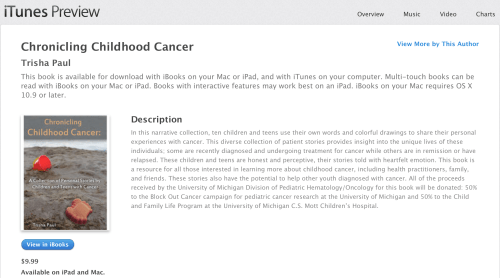
If you walk through the infusion clinic at Mott Children’s Hospital, you’ll notice a lot of patients have one thing in their hands: iPads! That’s why I’m excited to announce that Chronicling Childhood Cancer has now been released as an iBook, available for download on any iPad or Mac laptop.

With how widespread iPads are becoming for patients these days, I hope that these new version of the book will be more accessible and able to reach a broader audience. At the very least, I want this book to be available to patients and their families waiting in hospitals who may be interested in perusing it. And as always, all proceeds are donated: 50% benefitting the Block Out Cancer campaign for pediatric cancer research at the University of Michigan, and 50% benefitting the Child and Family Life Program at C.S. Mott Children’s Hospital.

It continues to amaze me how much this project just keeps on growing. A special thanks to Learning Design and Publishing at the University of Michigan Medical School for making this all happen, from the hard copy to the electronic version. I can’t wait to see what’s next!


Chronicling Childhood Cancer on iTunes

Leave a comment

Filed under Chronicling Childhood Cancer: Illuminating the Illness Experience through Narrative, Narrative Medicine Research

1 Week till The Examined Life: Writing, Humanities, and the Art of Medicine

“There is art to medicine as well as science.” -Hippocratic Oath

I find myself thinking about this quote a lot throughout medical school. It reminds me of what initially fascinated me about medicine. While following the pre-medical track lends itself to a scientific foundation for medicine, my non-traditional experiences illuminated the art of medicine to me.

Last year, I found my place at The Examined Life: Writing, Humanities, and the Art of Medicine conference. I was excited to be surrounded by so many other people interested and actively working at the intersections of literature and medicine. These are people who are passionate about all things related to healing and medicine, reading and writing, learning and educating. And I am thrilled to have the opportunity to attend this conference once again, one week from today.

Last year, around this time, I was teaching a mini-course called Grand Rounds: Exploring the Literary Symptoms of Illness through Narrative. This year, I will be leading a discussion forum about this course and about what implications it may have for the use of illness narratives in pre-health education. As I’ve been preparing for our session and sifting through course materials and relevant scholarship, I’m reminded of how much I miss teaching. It won’t be quite the same as leading one of my discussion classes, but I’m really looking forward to the conversations to come.

As a flashback to last year’s presentation: I will also have hard copies of Chronicling Childhood Cancer: A Collection of Personal Stories by Children and Teens with Cancer available for sale this year!
Screen Shot 2015-04-04 at 1.12.22 AM

Leave a comment

Filed under Chronicling Childhood Cancer: Illuminating the Illness Experience through Narrative, Grand Rounds, Narrative Medicine Research

Breaking blog silence

Hello, world!

It’s been awhile. Medical school has been busier than I expected, but now that I’ve (somewhat) transitioned into it and my first year is nearing its end, I’m hoping to slowly ease back into blogging. Time in medical school is strange and warped, and I find myself wanting to make the most of any and all free time that I have outside of studying by abstaining from technology, so it’s been challenging to maintain this blog. That being said, I’m ready to try.

Some exciting pieces of news to come in the next few weeks. Stay tuned!


1 Comment

Filed under Uncategorized

Chronicling Childhood Cancer: Ethical Considerations in Self-publishing the Work of Others

To publish a book: a dream held by many, achieved by few.

Until now. Self-publishing has revolutionized the world of books, forever altering what it means to be a published author. But what happens when an author is actually an editor responsible for a collection of works, none of which are her own?

This September, Chronicling Childhood Cancer: A Collection of Personal Stories by Children and Teens with Cancer was published. Edited by me, Trisha Paul, this collection of works consists of narratives collected from my research with pediatric oncology patients at C.S. Mott Children’s Hospital.

There are a lot of questions that I grappled with throughout the publication process, and they left me filled with both excitement and anxiety. What does it mean to self-publish a book that is entirely based on the contributions of others? Perhaps nothing, perhaps something. For me, it was important from the start that the focus remain on the children and teens with cancer.

Yet as the editor of this collection and the collector of these stories, I inevitably had the responsibility of making decisions regarding this publication. How much did I want to disclose about myself as the editor? If I was not including any images of the child and teen authors, was I comfortable including my own picture? How could I adequately summarize where this idea came from in the Preface without dwelling too much on my personal story?

Throughout the process, I kept wondering whether I was overthinking these seemingly minor details, but I always found myself agreeing with my initial concerns. These questions may seem superfluous or irrelevant, but they are the kind of concerns that I have contemplated from the start. Although the book may be attributed to me as the editor, I believe that it is not I who is being published but rather each of these contributing children. By making these important ethical considerations, I was able to achieve my ultimate goal: to maintain the focus on these young child and teen authors.

Leave a comment

Filed under Chronicling Childhood Cancer: Illuminating the Illness Experience through Narrative

Chronicling Childhood Cancer: About the Charities

All proceeds from the book Chronicling Childhood Cancer: A Collection of Personal Stories by Children and Teens with Cancer will support the following programs at C.S. Mott Children’s Hospital. These programs are near and dear to me, and I believe that they represent the multiple dimensions that we must address within the cause of childhood cancer:

Fifty percent benefitting the Block Out Cancer campaign for pediatric cancer research at the University of Michigan.

“C.S. Mott Children’s Hospital is home to the largest cutting-edge pediatric research effort in the state of Michigan. We believe every child deserves a cure, and we have established the Center for Childhood Cancer to help us find different, better ways to cure childhood cancers.”

“Our teams are conducting basic science, translational research and clinical research with a goal of finding new cures and better ways to deliver current treatments. Our research focus spans from early diagnosis and cancer prevention to developing less toxic treatments and exploring expanding horizons in life-long cancer survivorship so we can understand and improve the long-term effects of cancer therapies.”

Fifty percent benefitting the Child and Family Life Program at C.S. Mott Children’s Hospital.

“The Child and Family Life team at C.S. Mott Children’s Hospital is made up of trained professionals with expertise in helping reduce the stress and anxiety associated with hospitalization and illness.”

“Our Child and Family Life team members work together with doctors, nurses, social workers and others throughout the hospital to meet the emotional, developmental, and cultural needs of children and their families. Some of the special services we offer for patients and families include:

  • Procedure preparation medical play and support
  • Activity centers
  • Hospital school program
  • Art therapy
  • Music therapy”

Leave a comment

Filed under Chronicling Childhood Cancer: Illuminating the Illness Experience through Narrative