Teaching Illness Narratives through the Honors Program

I’m excited to announce that I will officially be teaching a mini-course about illness narratives this year!

The Honors Program at UM offers a unique opportunity for thesis-writing seniors: design a course and, if selected, teach it to first year students.

So I created my own syllabus and schedule/reading list for a course that I called Grand Rounds: Exploring the Literary Symptoms of Illness through Narrative.

This summer, I’ll be revising this syllabus and creating educational resources  to teach the course. It’ll be interesting to revisit some of the canonical works that I have studied over the past few months and rethink about them through an educational perspective.

I’m excited to get a sense of what teaching about illness narratives is like; since I hope to get involved in academic medicine and teach about this genre some day, I know this will be a great experience for me. And who knows, maybe I’ll even convert some students to be avid bloggers and illness narrative enthusiasts!

Leave a comment

Filed under Grand Rounds

Reconstructing the Past with ICU Patient Diaries

Image courtesy of Antonio Litterio under a Creative Commons license: BY-SA.

Image courtesy of Antonio Litterio: BY-SA.

In permeating across disciplines, illness narrative research attains a level of potency, one that spans the globe. Dr. Ingrid Egerod, a nurse from the University of Copenhagen, spoke on Tuesday about “ICU patient diaries and follow up in Nordic countries.” She highlighted how narrative is being used by ICU nurses to enhance care in Nordic countries.

What is unique about ICU patients is that many spend weeks at a time unconscious, and later they are unable to remember the ICU. This dark vacuum of memory can be the cause of alarm for many patients, creating friction that sparks psychological discomfort for a patient in later years.

In the Nordic countries, nurses like Ingrid Egerod aim to fill this void by creating ICU patient diaries to capture the day-to-day lives of these patients. Unlike hospital charts, these records string together ICU events to create a coherent ICU experience. These diaries then become tools to aid patients in reconstructing their time in the ICU and creating their own illness narrative.

These have had an incredible impact on many members of the ICU scene, ranging from nurses to families to patients. This task seems to renew a sense of purpose for nurses and to help families to understand the progression of medical events through story. Egerod and others have demonstrated that patient diaries decrease the occurrence of Post-Traumatic Stress Disorder in ICU patients. After patients are presented with their diaries, nurses follow-up with them  and use the diary as a guideline for conversation. These narrative activities are now being extended to include patients and families who are encouraged to use writing as a therapeutic form of expression.

It was fascinating to hear about this illness narrative research and to think about how narrative can adapt to and address the needs of the ICU unit and others. I also found it exciting to see that the idea of narrative is growing in other countries as well.

Here were some of the questions that I had, along with paraphrased answers provided by Dr. Egerod.

  • How are these ideas being received globally?

There appears to be enthusiasm for narrative and a growing appreciation for the patient experience, but especially in countries like the U.S. where nurses are often overwhelmed as it is, the obligation of ICU patient diaries can become a burden. This is definitely an obstacle, but it’s important to recognize the long-term benefits of this immediate investment; reducing psychological distress from the start can lead to less problems down the road.

  • Have there been efforts to publish these narratives so that other patients and health professionals can learn from these experiences?

Not so much, due to the intimacy of these narratives. Excerpts have been cited in journal articles, but these diaries have been primarily a resource for the immediate people involved in each narrative.

  • How do physicians play a role in the ICU patient diaries?

It seems as though physicians are more backstage for these efforts. Nurses have adopted the ICU patient diaries as something of their own, and doctors are less involved actively in the daily care.

I guess that’s what I’m trying to push again with my illness narrative research. I am glad to see that health professionals such as nurses are becoming more involved in narrative work, but I think that this is just as crucial for physicians. There may not be time for this level of engagement on each person’s part, but I believe that at least an awareness by all health professionals would make a difference.

48 Comments

Filed under Miscellaneous Musings, Narrative Medicine Research

A Summer Reading List

A friend asked for suggestions for a booklist, so I figured I’d craft one here. This particular list focuses on historically contextualized texts and artistic representations.

Books for History of Medicine Enthusiasts:

1. The Emperor of All Maladies: A Biography of Cancer, Siddhartha Mukherjee

A comprehensive documentation of Cancer’s transformation over the years. Mukherjee skillfully weaves the narratives of patients, physicians, and researchers with the political, social, and scientific evolution of the disease.

2. The Immortal Life of Henrietta Lacks, Rebecca Skloot

A canonical work about the famous HeLa cells. Skloot digs deeper into the woman behind these immortal cervical cancer cells: Henrietta Lacks, who never knew that her cells were taken, grown, and sold without her consent. This book explores the racial inequities of health care in the US, and tells the story of the Lacks family and how they have been impacted by this experience.

3. The Spirit Catches You and You Fall Down, Anne Fadiman

Another canonical book in Medical Anthropology, one that provides a more cultural spin on health disparities. Fadiman tells the story of Lia Lee, a Hmong child in California, whose severe epilepsy illuminates the cultural clashes between her Hmong family and Western doctors.

4. Cutting for Stone, Abraham Verghese

A gripping piece of fiction that follows the story of the Stone family over the years. With a cultural backdrop of Addis Ababa, Ethiopia, and a focus on the art of surgery,the reader is immersed into a different realm of medicine. 

Books for Art of Medicine Enthusiasts:

5. Stitches, David Small

A potent graphic novel set in Detroit about how cancer physically stripped Small of his voice and its psychological effects. As a talented artist himself, Small uses imagery to fill in the spaces where language falls short.

6. The Diving Bell and the Butterfly (literature and film)

These works coupled together provide a good portrayal of Jean-Dominique Bauby’s experience with full body paralysis. I suggest reading the book before viewing the film to approach the viewing experience with a more authentic perspective.

Happy reading!

2 Comments

Filed under Miscellaneous Musings

Show & Tell: A Presentation and Discussion about My Narrative Research

On June 5th, I’ll be giving a 20 minute presentation about my thesis research project to the entire Pediatric Oncology care team at Mott Children’s Hospital. Physicians (attendings, fellows, residents, medical students), nurses, nurse practitioners: all the individuals involved in the care of these children will be introduced to what my research is all about.

In preparation for this incredible honor, I wanted to participate in the Show & Tell series conducted by the Office of Enabling Technologies office at the Med School. My colleagues at Open.Michigan and  ET are some of the most enthusiastic and supportive individuals I’ve met; I wanted to get their feedback about my presentation and  give them a better sense of what I’m doing outside the office.

Overall, I would say that the presentation went pretty well. There’s still more for me to work on (as always), but it was interesting to find how much my passion for the project helped me organize and convey my thoughts.

Here’s the abstract and slides from the Show & Tell presentation–

Topic: Chronicling Childhood Cancer: Illuminating the Illness Experience through Narrative

Illness narratives, stories about the experience of being ill, are becoming increasingly appreciated by health professionals and by patients. I’ll be presenting about my own research in this realm at Mott, exploring how children with cancer express their illness experience through narrative. I’d like to have a discussion about what can be done with these narratives (publishing a book, etc.) and how technology can be involved in extending research that is centered on the patient experience. I’ll be giving a similar presentation about my research project to the Pediatric Hematology/Oncology department in June, so I’d appreciate any feedback about the presentation and the future of this project.

Chronicling Childhood Cancer- Show & Tell Presentation

Leave a comment

Filed under Chronicling Childhood Cancer: Illuminating the Illness Experience through Narrative

In Honor of Zach Sobiech

An incredible kid with an inspirational story about living life in the face of death:

For Zach, “life is really just beautiful moments, one right after the other.”

Faced with the terminal diagnosis of osteosarcoma, he realized that “my closure is being able to get my feelings into these songs.” Zach’s own illness narratives took the form of music.

Zach died this past Monday, “fly[ing] up a little higher.”

2 Comments

Filed under Chronicling Childhood Cancer: Illuminating the Illness Experience through Narrative, Film, Voice

ICD Connection: Inspiring Illness Narrative Publication

After reading and reviewing  the illness narrative ICD Connection: Living with an Implantable Cardioverter Defibrillator: A Collection of Patient & Family Stories, I feel that I need to explain another facet of this book. This book has also entirely revolutionized my own research.

When I found out that this book had published, I was shocked to see this publication of illness narratives come to fruition right here at the University of Michigan. I couldn’t help but wonder: would it be possible to do the same with the narratives that the pediatric oncology patients create? After all, one of the main motivations for conducting this research was because of the void in published illness narratives by children themselves. So why not fill that void?

That’s when I got in touch with MPublishing and explained to them my research project and why this was important to me. I wanted the children participating in my research to really gain something meaningful from being a part of the study; I wanted them to be proud of their narrative. I hope that children will find fulfillment in sharing their stories with the health professionals that treat them, the loved ones that care for them, and all the other kids with cancer.

MPublishing agreed, and I couldn’t be happier. We’ll have to wait and see how everything turns out, but the plan is to have publishing be a separate opportunity from the research component of my project. While I will study these narratives anonymously, children can choose how much of their identity they would like to disclose in the publication.

At the end of it all, the children will be able to hold this book in their hands, to flip through the pages, and find their own words. They will be able to share their story with the world.

Leave a comment

Filed under Chronicling Childhood Cancer: Illuminating the Illness Experience through Narrative

ICD Connection: Illuminating the Patient Experience

For months, I have been eager to read ICD Connection: Living with an Implantable Cardioverter Defibrillator: A Collection of Patient & Family Stories. I’ve heard so much about this book through working at the UM Medical School, and it’s been exciting to watch UM transform these works into a published creation that gives ICD patients a voice.

ICD stands for Implantable Cardioverter Defibrillator. “It is a device smaller than a deck of cards that is implanted under the skin to treat life-threatening heart rhythms that can lead to sudden cardiac arrest” (McFarland: Pelosi i). While the ICD certainly saves lives, policing the heart’s every  heartbeat, it brings with challenges of its own. This is what the patients and families featured in the ICD Connection book aim to illuminate.

The idea behind this book came from the Young ICD Connection event, which brings together people from around the country who are living life with an ICD. This event inspired Helen McFarland, a nurse who has worked with ICD patients for years, to create this compilation of stories. She was eager to explore the psychological and social side effects of the ICD, to enable patients and families to tell their stories to have their voice be heard.

I must say, this collection has been one of my favorite set of illness narratives. The honesty and authenticity of these stories and the genuine intentions behind writing them shine through, empowering this collection to have resounding effects on any reader. Each short story was unique and moving, and the writers brought incredible insight about their own lives and the ways that the ICD had affected them from within. These stories reflected the perspectives of boys and girls, men and women, dads, husbands, and daughters. I loved the eclectic selection of experiences that all seemed to supplement each other but also stand apart. For example, the pairing of Erika’s perspective of having an ICD with Bryan, her husband’s perspective of her ICD, was interesting to explore.

Amongst many powerful ideas, I found one statement that seemed to reflect the foundation behind this book. “Emotional roller coasters are a very normal part of any health challenge, and every patient has a right to feel however he or she feels and work through those emotions in whatever way he or she needs to. No one is the same, and no one deals with anything exactly the same” (McFarland: Lisa 85-86).

1 Comment

Filed under Literary Narratives

Beating Breast Cancer: Angelina Jolie’s Mastectomy

Angelina Jolie’s story of a mastectomy has been permeating through media. With a high genetic risk for breast cancer (>85%), Jolie made the conscious decision that she would not let herself fall victim to cancer. She chose to have a double mastectomy, ridding her body of potentially cancerous cells and replacing them with breast implantations.

Her Op-Ed piece in the New York Times is an interesting and well-written piece, and her decision to undertake a preventive mastectomy all the more admirable. But there was one thing that I wish she had explored more: why the need for the breast implantations following the mastectomy?

I ask this because in reading her piece, I was reminded of Audre Lorde’s The Cancer Journals (as I always am when I hear about breast cancer now). Lorde vehemently critiques the prosthetic breast, suggesting that it is a materialization of societal expectations for women rather than a functional physiological necessity.

Although I realize that Lorde’s strong sense of identity set apart her somewhat controversial critique of the prosthetic breast, it has made me question them more. I imagine that Jolie’s identity as an actress demands for her prosthetic breasts, but I wish she had spoken more about this second, equally important decision in her story. This decision becomes buried beneath the mastectomy, almost as though it was not a decision at all but rather an expected follow-up course of action.

In reading her story, I also think it’s interesting to consider the effects of illness on celebrities. As I opened the article, I was taken aback to realize that I actually recognized the name of the author. I wonder how an illness narrative is altered by a person’s identity as a celebrity and how this impacts its resonance with readers.

It seems like it was Jolie’s awareness of this difference that encouraged her to write this piece, to share her battle, to tell her story.

Leave a comment

Filed under Literary Narratives, Miscellaneous Musings

“Artful Medicine”: Surgery, Microscopes, and Plastination

Understanding medicine as an art is complex; it encompasses a number of facets. For one thing, the praxis itself is an art, but its roots also stem from a visual form of art.

1. Surgery

This is a great collaborative effort at Stanford to enhance surgical education through artistic representation. 

2. Microscopes

Which reminded me of one of my old favorite, Bioartography. This looks at disease through the lens of microscopic imaging.

Bioartography

3. Plastination

Which got me thinking about Body Worlds. The plastination of bodies are transformed to sculptures of art.

Art is deeply intertwined in our understanding of the human body, from a cellular level to a physiological level to an anatomical level and beyond. It’s interesting to consider these three perspectives on the art of medicine because they illuminate the fact that  this concept and this initiative is entirely natural.

But at the same time, exhibits like Body Worlds have raised ethical concerns about artistically displaying a body. Although plastination originated with educational intentions, the body has become commodified and manipulated. Is there somewhere we should draw the line between art and medicine?

Leave a comment

Filed under Visualizing Illness

Dear Cancer…

I kind of love this:

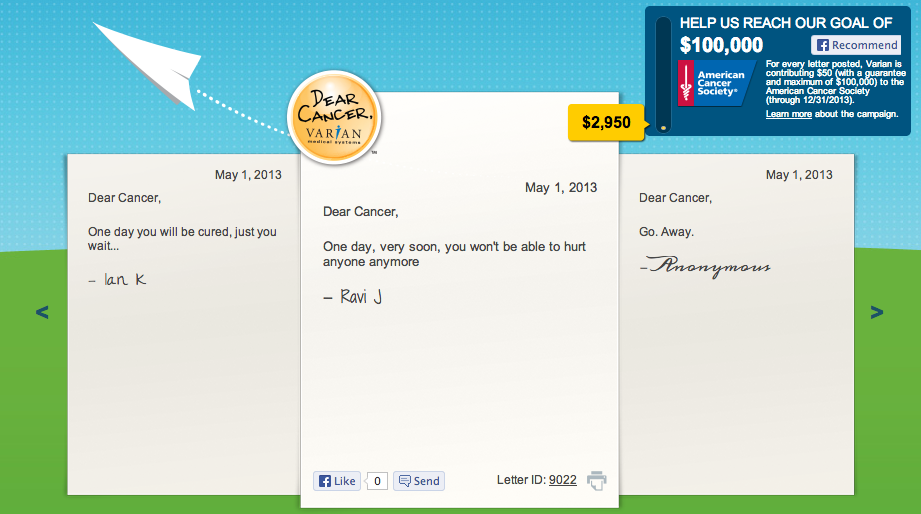
Screen Shot 2013-05-08 at 12.51.47 PM

One of the most intriguing things about cancer is that we as a society respond differently to this illness than to others. We have personified cancer, transforming this disease into a being. 

So here’s my question: why? What about cancer has made it particularly tempting to personify, and what are the effects of this personification?

I believe that the question why cancer? is pretty loaded, so I’ll be unpacking that in some upcoming posts. For now, I’d like to think more about the effects of personification.

Understanding cancer as a being transforms the abstract into something tangible. This familiarity deflates cancer to our plane, simultaneously empowering us in the face of illness. We’ve accepted this as a part of our coping mechanism, promoting organizations that invert the power dynamics of cancer such as  Cancer Fears Me

Writing letters to cancer has a similar function for patients, as evidenced by this fascinating fundraiser for the American Cancer Society. As a strong proponent of writing as a therapeutic process in the face of illness, I think that letter-writing can be incredibly empowering. It’s fascinating to see how people address cancer: some violently and aggressively command cancer to follow their mandates, while others respond more passively to its malicious nature and tempestuous effects.

If you were to write a letter to cancer (which you should do here), what would you say? How would you say it? And why?

1 Comment

Filed under Chronicling Childhood Cancer: Illuminating the Illness Experience through Narrative, Literary Narratives