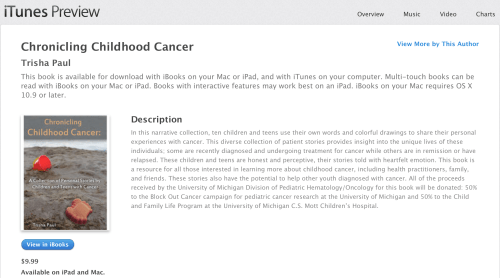
If you walk through the infusion clinic at Mott Children’s Hospital, you’ll notice a lot of patients have one thing in their hands: iPads! That’s why I’m excited to announce that Chronicling Childhood Cancer has now been released as an iBook, available for download on any iPad or Mac laptop.
With how widespread iPads are becoming for patients these days, I hope that these new version of the book will be more accessible and able to reach a broader audience. At the very least, I want this book to be available to patients and their families waiting in hospitals who may be interested in perusing it. And as always, all proceeds are donated: 50% benefitting the Block Out Cancer campaign for pediatric cancer research at the University of Michigan, and 50% benefitting the Child and Family Life Program at C.S. Mott Children’s Hospital.
It continues to amaze me how much this project just keeps on growing. A special thanks to Learning Design and Publishing at the University of Michigan Medical School for making this all happen, from the hard copy to the electronic version. I can’t wait to see what’s next!
To publish a book: a dream held by many, achieved by few.
Until now. Self-publishing has revolutionized the world of books, forever altering what it means to be a published author. But what happens when an author is actually an editor responsible for a collection of works, none of which are her own?
This September, Chronicling Childhood Cancer: A Collection of Personal Stories by Children and Teens with Cancer was published. Edited by me, Trisha Paul, this collection of works consists of narratives collected from my research with pediatric oncology patients at C.S. Mott Children’s Hospital.
There are a lot of questions that I grappled with throughout the publication process, and they left me filled with both excitement and anxiety. What does it mean to self-publish a book that is entirely based on the contributions of others? Perhaps nothing, perhaps something. For me, it was important from the start that the focus remain on the children and teens with cancer.
Yet as the editor of this collection and the collector of these stories, I inevitably had the responsibility of making decisions regarding this publication. How much did I want to disclose about myself as the editor? If I was not including any images of the child and teen authors, was I comfortable including my own picture? How could I adequately summarize where this idea came from in the Preface without dwelling too much on my personal story?
Throughout the process, I kept wondering whether I was overthinking these seemingly minor details, but I always found myself agreeing with my initial concerns. These questions may seem superfluous or irrelevant, but they are the kind of concerns that I have contemplated from the start. Although the book may be attributed to me as the editor, I believe that it is not I who is being published but rather each of these contributing children. By making these important ethical considerations, I was able to achieve my ultimate goal: to maintain the focus on these young child and teen authors.
With a day full of rain, hail, and even thunder-snow, we elected to spend classtime watching the film adaptation of Margaret Edson’s play W;t. We decided to save our discussion of Audre Lorde, Angelina Jolie, and breast cancer for the following week, where guest speaker Dr. Janet Gilsdorf was coming in to speak about her experiences as a physician and as a breast cancer patient. I had been worried about how to show excerpts of W;t and do the film justice (I think it’s an incredibly powerful work), so I was happy to be able to show it to them in its entirety.
It’s one thing to be sitting in a classroom discussion as a student– its something entirely different to be leading the discussion as an instructor. I’ve enjoyed teaching scientific facts and promoting inquiry-based learning in science, but it’s a new experience for me to be leading discussions rooted in my literary interests.
It really makes a difference to have an enthusiastic group of students and a classroom where we can sit in a circle. I taught about the history of illness narratives, which I’m simultaneously writing about for my thesis. It was a strange experience to be crafting leading questions by voice that I have also been trying to ask in my writing.
I think one of my teaching goals for the semester is to get better at tackling silences. There’s an art to teaching in silence, to allowing quiet to linger for just long enough for thought generation, without letting this surpass into daydreams and uncomfortable, awkward silences. I’m working on it.
It was a thought-provoking first discussion class, and I’m looking forward to keeping the conversations going. Up next: excerpts from Sylvia Plath’s The Bell Jar and her poems Lady Lazarus and Tulips.
One week ago was the first day of my Honors 135 course, Grand Rounds: Exploring the Literary Symptoms of Illness through Narrative. It was exciting to start and to meet all my students, and I’m really looking forward to an interesting and enlightening semester.
I’ve been struggling to decide exactly how I would like to showcase my course and my thoughts about teaching on this blog. For the time being, I’ve decided to focus on my own instruction materials. I might discuss new ideas that arise in class, but to honor the sanctity of our classroom discussion, I might withhold these thoughts until the end of the semester and reflect on the course as a whole at that time.
And so, here are the openly licensed materials from our first day of class:
In honor of Franz Kafka’s 130th birthday today, Google chose to illustrate one of Kafka’s most canonical works: The Metamorphosis. This classic novella was one of the first illness narratives that I read, telling the symbolic tale of the salesman Gregor whose illness transforms him into a “monstrous verminous bug” (1).
It’s interesting what a different feel this image has. The drab colors reflect the simplistic tone in the book. But the sense of entrapment and isolation conveyed in Kafka’s work is inverted here by a mobile insect in control of his limbs. And the apple, a weapon that injures Gregor, becomes raised on the pedestal-like letter L. There is no sense of the pain and torment that Gregor experiences from the illness in the novella.
This doodle has me thinking about images and their effects on literature. Since I saw this image after reading the book, it was a bit unsettling for me. But if I had seen this image prior, perhaps I would have left the text with a different sentiment. I wonder how book covers of illness narratives may sway perceptions of illness.
It was exciting to be in a room full of people who care about the same kids that I do. I was sandwiched between a talk about clinical procedures/research protocols and patient care deliberations; I was a bit frazzled at first, but it was an honor to have the opportunity to present my English thesis research project to the Pediatric Oncology Care Team at Mott Children’s Hospital.
I loved looking out into the conference room and recognizing people who I’ve been learning from and working closely with over the past few weeks. Realizing that they were all here and interested in what I had to say.
As always, I felt as though I could have spoken better, but overall my research project presentation was a huge success. Everyone contributed valuable insight about the project, and I’ve captured some of the ideas that arose here:
When is it too early to approach patients after a new diagnosis?
There were mixed ideas about this. Some people thought that immediate diagnosis would leave patients and families more sensitive and vulnerable, so maybe we should wait to reach out to them. Others recognized that this is a valuable time within the illness experience. I’m not sure that we reached a consensus about this, but it will be something to keep in mind through recruitment.
What kind of editing will be done with the child’s narratives?
My goal is to keep these narratives as authentic as possible. I ideally do not want any editing of these narratives to occur prior to publishing; I want these narratives to be published with misspellings and all.
Will you be noting that your perspective as the sole researcher is subjective?
This was an interesting idea that I hadn’t thought about it, but it’s incredibly true. My presence during this narration and my in-person encounter with these children, these authors, will certainly bias my own perspectives and insight into these narratives. This is especially true considering that I am the only researcher who will be working with these children. I need to think about the implications of this idea more, but I’m glad it was brought up.
After the talk and discussion, it was incredible to sense the energy everyone had. The environment was charged with enthusiasm; everyone was impressed with how far this project has come and the potential it holds. I’m so glad that I will be able to work closely with these caring staff, and I hope that this research will transform the experience of these patients.
I was touched that a few people came up to me afterwards to suggest the following:
A compelling video created by a pediatric oncology patient at Mott. Mary has documented her experience with cancer through photography, and she has composed a powerful song to accompany it.
—
I still have a lot to think about over the next few weeks (while I’m in Kenya!), but I can’t wait for my research to begin.
Angelina Jolie’s story of a mastectomy has been permeating through media. With a high genetic risk for breast cancer (>85%), Jolie made the conscious decision that she would not let herself fall victim to cancer. She chose to have a double mastectomy, ridding her body of potentially cancerous cells and replacing them with breast implantations.
Her Op-Ed piece in the New York Times is an interesting and well-written piece, and her decision to undertake a preventive mastectomy all the more admirable. But there was one thing that I wish she had explored more: why the need for the breast implantations following the mastectomy?
I ask this because in reading her piece, I was reminded of Audre Lorde’s The Cancer Journals (as I always am when I hear about breast cancer now). Lorde vehemently critiques the prosthetic breast, suggesting that it is a materialization of societal expectations for women rather than a functional physiological necessity.
Although I realize that Lorde’s strong sense of identity set apart her somewhat controversial critique of the prosthetic breast, it has made me question them more. I imagine that Jolie’s identity as an actress demands for her prosthetic breasts, but I wish she had spoken more about this second, equally important decision in her story. This decision becomes buried beneath the mastectomy, almost as though it was not a decision at all but rather an expected follow-up course of action.
In reading her story, I also think it’s interesting to consider the effects of illness on celebrities. As I opened the article, I was taken aback to realize that I actually recognized the name of the author. I wonder how an illness narrative is altered by a person’s identity as a celebrity and how this impacts its resonance with readers.
It seems like it was Jolie’s awareness of this difference that encouraged her to write this piece, to share her battle, to tell her story.
The past month has been a flurry of wrapping up the semester and delving into the medical school application process, but I’ve also felt as though I was suspended within a strange state of liminality. I’ve been trying to define my research in the immediate future, but I’ve also been looking beyond that to try to figure out what I hope to accomplish with my passion for illness narratives and how far I can take it through my career in medicine.
I’ve come to realize that ultimately, my primary goal is to become a practicing clinical physician: currently, I hope to be a pediatric oncologist, but I recognize and accept the fact that all that may change in medical school. At the same time, the deeper I delve into the intersection of literature and medicine, the more aware I become of the illness narratives that surround our culture, the more I realize that this semester-long independent study barely scraped the surface. Although I sampled the genres of illness narrative theory, short story, novel, autobiography, memoir, poetry, art, dance, film, and more, there is just so much more for me to explore.
My interest in illness narratives is three-fold: learn, research, teach.
LEARN: Studying illness narratives has helped me to better understand the experience of illness, and I believe that this exploration is vital to making me a better physician.
RESEARCH: Making sense of existing illness narratives and conducting research to promote the generation of new ones has helped me to understand literature, to understand medicine, and to understand their intertwinement.
TEACH: Exposure to illness narratives has entirely changed my understanding of medicine, and I believe that this awareness and perspective is crucial for prospective doctors, so I hope to share my knowledge about this field with others and to promote the general education of illness narratives.
Through all this, it’s become clear to me that no matter where I go for medical school, I am entirely keen on continuing to study illness narratives. And I’ve realized that I can share the process of learning, researching, and teaching in this field with others through the wonderful world-wide web. And so, my blog has abandoned the ‘.word press.’ in favor of simply ‘.com.’
My blog has always been for me, a somewhat personal space where I can reflect naturally, and I hope to preserve my original intent with an added twist. I never wanted to publicize my blog because I was writing only for me, but as I’ve watched people from around the world stumble across it, I’ve realized that there might be other illness narrative enthusiasts who just haven’t quite found the field yet. By turning my blog into a website (I still can’t believe the domain name was even available!), I hope that I can create a centralized space based on the familiarity that I’ve gained with the field.
Six months later, my journey is just beginning. And I’m excited to see how this narrative unfolds.



 Investigating Illness Narratives